EV Charger Adapters for International Travel 2026: Critical Guide to Cross-Border EV Charging Standards and Compatibility
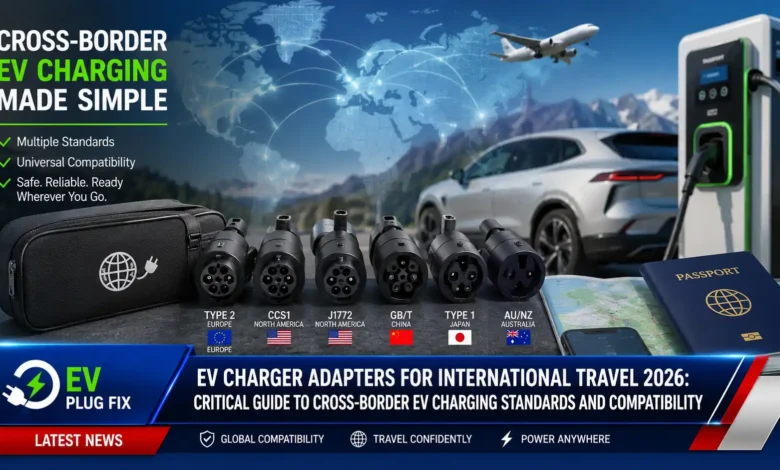
EV charger adapters for international travel are rapidly transitioning from a niche accessory to an essential piece of equipment for any electric vehicle owner planning to drive across borders in 2026. The global landscape of EV charging is a complex patchwork of competing standards, physical connectors, and regional regulations that can turn a cross-country road trip into a logistical puzzle without the right preparation . Unlike refueling a petrol or diesel car, where the pump is universal, charging an EV requires a nuanced understanding of compatibility. Fortunately, modern vehicles and a growing market of sophisticated adapters are providing the keys to unlock a world of mobility, ensuring that range anxiety doesn’t turn into international travel anxiety.
The Fragmented Reality of Global EV Charging Standards
The need for EV charger adapters in international travel arises from a simple historical fact: the world’s major automotive markets developed their electric vehicle infrastructure independently. This has resulted in a fragmented ecosystem of five dominant charging standards, each with its own physical plug, communication protocol, and regional stronghold . For drivers concerned about long-term compatibility, understanding how these standards interact with EV Battery Lifespan can help in planning charging strategies that preserve battery health across different networks.
- North America: The landscape is defined by the North American Charging Standard (NACS), originally developed by Tesla and now adopted by major manufacturers like Ford and GM, and the legacy CCS1 (Combined Charging System 1) standard which is still a massive part of the existing infrastructure .
- Europe, Australia, and South Korea: Have converged on CCS2, the most widely adopted standard globally, which is mandatory for the European Union. It builds upon the Type 2 (Mennekes) AC plug .
- China: Operates under the completely distinct GB/T standard, which is exclusive to the Chinese market and widely used in other parts of Asia and South America due to the sheer size of the Chinese EV market .
- Japan: Maintains the legacy CHAdeMO standard, though it is being gradually phased out globally in favor of CCS2 and NACS .
This divergence creates immediate practical challenges. A vehicle equipped with a CCS1 connector cannot directly charge at a CCS2 station common throughout Europe, and a Chinese-manufactured EV with a GB/T port will find itself incompatible with most chargers in North America or Europe . Understanding regional electricity costs is equally important; for instance, Germany EV Electricity Prices can significantly impact the cost-effectiveness of your charging stops while traveling through Europe.
Over 60% of public charging points in the EU are concentrated in just three countries: the Netherlands, Germany, and France, highlighting the uneven development of infrastructure even within a region with a unified standard .
Distinguishing Adapters from Voltage Converters
Before exploring the significance of EV charger adapters, it is crucial to understand how they differ fundamentally from voltage converters. As explained in basic travel electronics, an adapter merely modifies the physical connection between a device and an outlet, allowing plugs designed for one region to fit into sockets configured for another. It does not alter the electrical current .
Why EV Charger Adapters Are Indispensable for International Travel
Enabling True Cross-Border Mobility
The primary benefit is enabling truly global mobility. Without an adapter, an EV driver moving from North America to Europe would face a charging network completely incompatible with their vehicle . Adapters solve this problem elegantly by acting as translation mechanisms between incompatible standards. A North American driver can carry a CCS1-to-CCS2 adapter, instantly converting their vehicle’s capability to access Europe’s extensive charging network. Conversely, a European EV owner driving in North America can use an NACS-to-CCS1 adapter to access the rapidly growing Tesla Supercharger network or other NACS-equipped stations . For those planning longer trips, staying informed about EV Charging Data Standards can help in understanding how different networks communicate charging information across borders.
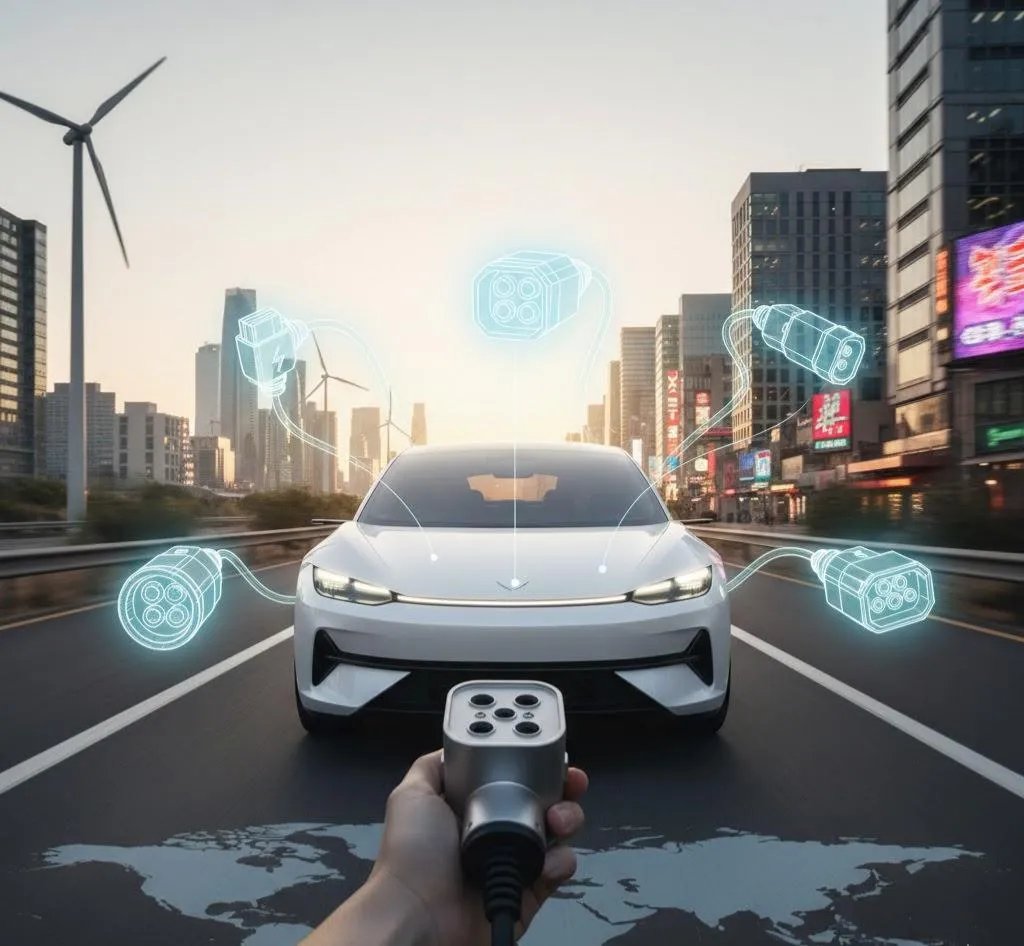
Understanding the differences between global EV charging standards is the first step to a successful international road trip.
Cost-Effectiveness and Rapid Deployment
From an infrastructure perspective, adapters represent the most pragmatic near-term solution to fragmentation. Retrofitting thousands of existing charging stations would cost billions and require years of coordination. Adapters offer an instant, plug-and-play deployment, requiring zero infrastructure modifications . The global market for EV charging adapters was valued at over $2.3 billion in 2025 and is projected to grow at a staggering 20.2% CAGR, reaching $8.4 billion by 2032, underscoring their critical role in the EV ecosystem .
Addressing Infrastructure Gaps and Transitions
The global EV market is in a transition period. As the charging infrastructure grows, adapters provide crucial flexibility. They enable EV drivers to travel through regions where infrastructure may not yet be standardized to their specific vehicle type. Furthermore, as the industry transitions towards a more unified standard, adapters allow drivers of older vehicles with legacy ports to continue using new and existing networks .
EV Charging Adapters Market: A Booming Industry
The critical function of these adapters is reflected in the rapid growth of the EV Charging Adapters Market. As the installed base of EVs grows, so does the need for interoperability solutions. This market is a vital component of the broader EV ecosystem, supporting the expansion of charging networks and the global adoption of electric vehicles . The market is segmented by connector type, including Type 1, Type 2, CHAdeMO, and CCS Combo, and by application, covering residential, commercial, and industrial sectors .
| Standard | Region | Primary Use | Max DC Speed | Key Feature |
|---|---|---|---|---|
| NACS | North America | Home & Fast Charging | 350kW+ | Slim, unified AC/DC design . |
| CCS1 | North America | Fast Charging (Legacy) | 350kW | Bulkier “Combo” with a latch, widely deployed . |
| CCS2 | Europe / World | Universal Charging | 350kW+ | Mandatory standard for EU/UK/Australia . |
| GB/T | China / Belarus | Home & Fast Charging | 250kW-1.2MW | Uses separate AC and DC ports . |
| CHAdeMO | Japan / Global | Fast Charging (Legacy) | 100kW+ | Legacy standard, declining support . |
How to Choose the Right EV Charger Adapter for Your 2026 Trip
1. Identify Your Vehicle’s Native Standard
Start by checking your owner’s manual or the port on your EV to confirm its native charging standard. This is the foundation for your adapter selection . For example, a Tesla with NACS might need a CCS1 adapter in the U.S. or a CCS2 adapter in Europe. Understanding your vehicle’s battery capabilities, including Tesla Battery Lifespan, can help you make informed decisions about which charging speeds are optimal for your specific model.
2. Research Your Destination’s Charging Infrastructure
Before you go, research the dominant charging standards of the countries you plan to visit . Apps like PlugShare or A Better Routeplanner are indispensable for mapping charging stations and confirming connector types .
3. Evaluate Key Technical Specifications
Not all adapters are equal. It is vital to select an adapter with the correct specifications for safety and performance.
- AC vs DC Capability: Ensure the adapter is designed for the correct type of charging. An AC adapter for Level 2 charging cannot be used for DC fast charging .
- Amperage and Power Ratings: Choose an adapter that matches your vehicle’s maximum charging capability. An undersized adapter will limit your charging speed or could pose a safety risk .
- Waterproofing (IP Rating): For outdoor use, look for an adapter with at least an IP65 rating to protect against dust and water . EV Charger Protection Ratings are critical when charging in varying weather conditions during international travel.
- Certifications: Always prioritize safety and look for adapters with third-party certifications like UL (North America), CE (Europe), or TUV, which ensure they have been tested for electrical safety and thermal management .
Practical Considerations and Future Outlook
While the technical aspects are paramount, practical factors also play a significant role in a successful international journey. Carrying multiple adapters provides redundancy, as charging station downtime, availability fluctuations, and even payment system variations can force drivers to seek different charging options. The weight and compactness of modern adapter hardware make carrying a few options practical for most drivers . Additionally, using real-time charging planning apps helps drivers identify compatible chargers along their routes before departing, eliminating the risk of arriving at a station only to discover incompatibility.
Bridging the Gap: The Path Forward
The fragmentation of global EV charging standards appears destined to persist for the foreseeable future. Retrofitting existing infrastructure and manufacturing vehicles to legacy standards represents an enormous economic and engineering challenge. The global EV charging adapters market is projected to grow significantly, reaching $8.4 billion by 2032, driven by the need for interoperability during this transition . This growth is fueled by the rapid expansion of the electric vehicle market and the push for standardization in charging technologies .
However, consolidation is on the horizon. CCS2 has emerged as the globally dominant standard for new installations across the European Union, and NACS is gaining significant ground in North America. As vehicle manufacturing continues shifting toward these global standards and charging networks mature, the prevalence of minority standards like CHAdeMO will decline, reducing the number of adapter types required for routine international travel. Until that standardization occurs, however, adapters will remain indispensable tools for drivers seeking to explore the world in their electric vehicles .
The global EV charging adapters market is estimated at US$1.3 Billion in 2025 and is projected to reach US$4.4 Billion by 2032, growing at a CAGR of 19.6%, demonstrating how crucial interoperability is for the EV ecosystem .
Conclusion
Electric vehicle charger adapters exemplify how practical engineering solutions can address enormous infrastructure coordination challenges. They are the physical keys that unlock global mobility, reduce infrastructure investment requirements, and accelerate the adoption of electric transportation across diverse regions. By enabling physical compatibility between incompatible charging standards, adapters ensure that the international EV driver is not just a traveler, but a global citizen of a new, more connected world. Understanding the importance of adapters, selecting the appropriate models, and incorporating them into your travel planning is essential knowledge for any driver contemplating international EV travel in 2026 and beyond.