EV Charging Efficiency Losses Explained: Save Energy & Money in 2026
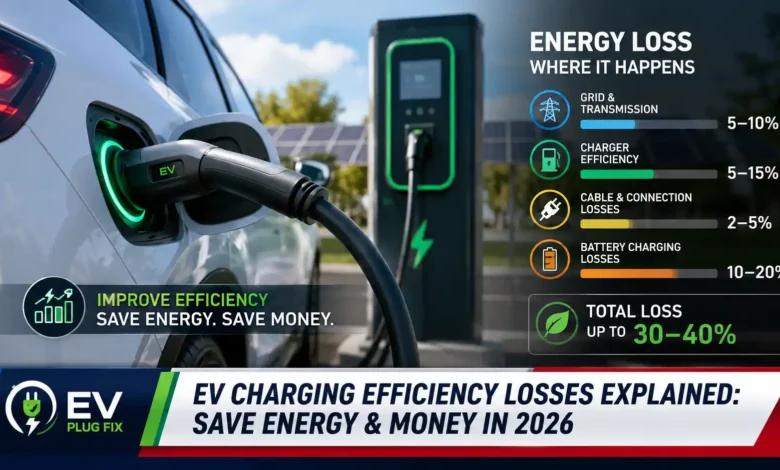
EV charging efficiency is not a perfect 1:1 transfer of electricity from the grid to your battery, and understanding where these energy losses occur is the first step to saving money and maximizing your electric vehicle’s potential in 2026. When you plug in your EV, the overall efficiency typically ranges from 80% to 95% . This means that for every 10 kilowatt-hours (kWh) you pay for, only 8 to 9.5 kWh actually makes it into your battery. Over the lifespan of your vehicle, these seemingly small percentages can translate into thousands of dollars in wasted electricity and needless carbon emissions. Understanding the EV Charging Speed Factors that influence this process is essential for any EV owner.
Where Does the Energy Go? The 5 Main Loss Points
-27.jpg)
1. AC to DC Conversion Losses
The most significant loss occurs when your home charger (Level 1 or 2) uses alternating current (AC) from the grid, but your EV’s battery stores direct current (DC). This crucial conversion happens in your vehicle’s onboard charger, which is essentially a complex power electronics system. This process is not 100% efficient, and a typical onboard charger accounts for roughly 10-15% of total energy losses . The heat you might feel emanating from your charger or charging cable is a direct byproduct of this conversion process. Higher-quality chargers, particularly those using advanced materials like silicon carbide, are pushing peak efficiencies to around 95% . To better understand the broader picture, review our EV Charging Levels Guide for a visual breakdown of the different charging options available.
2. The Impact of Battery Chemistry and Temperature
Your EV’s lithium-ion battery is a sensitive chemical system, and its charging efficiency is heavily dependent on temperature. The optimal operating range is between 20°C and 25°C (68°F to 77°F). Deviating from this sweet spot leads to significant energy losses.
- Cold Weather: In temperatures below 0°C (32°F), internal resistance increases and chemical reactions slow down. Your vehicle will use its own energy to heat the battery before and during charging, potentially consuming 20-30% more electricity.
- Hot Weather: Above 35°C (95°F), the battery’s cooling system activates to prevent damage, consuming additional energy and reducing overall efficiency.
The battery management system (BMS) works constantly during charging to manage cell balance, temperature, and safety. While essential for longevity, this system typically consumes 2-5% of charging energy.
3. Cable and Connection Resistance
Electrical resistance in your charging cable and connections causes energy to be lost as heat. This is governed by a basic principle of physics: the longer the cable and the thinner the wire, the higher the resistance and the greater the loss. A typical Level 2 cable might have a resistance of 0.1-0.3 ohms. At 32 amps, this translates to 100-300 watts of power lost as heat. Using shorter cables, choosing thicker gauge wires, and keeping connection points clean and tight is vital to minimize these losses. Proper EV Cable Management Systems can help you maintain optimal cable conditions and reduce unnecessary wear.
4. The “Vampire Drain” and Standby Power
Your EV is never truly “off.” Even when parked and not charging, it consumes power for essential systems like the BMS, security, onboard computers, and cellular connectivity. This can draw anywhere from 0.5 to 2 kWh daily, depending on the model and settings. Additionally, many charging stations themselves consume 5-20 watts of standby power when plugged in, even if not actively charging. Disabling unnecessary features like “always connected” modes or excessive cabin overheat protection when not needed can save 1-2 kWh daily.
5. The DC Fast Charging Trade-off
While DC fast chargers bypass the vehicle’s onboard converter by sending DC power directly to the battery, they are not the most efficient option. The extreme charging speeds generate substantial heat, forcing the battery’s cooling system to work overtime. While Level 2 charging generally operates at 88-94% efficiency, DC fast charging typically runs at 85-90% efficiency . For a detailed comparison of the different fast charging technologies, see our guide on EV Fast Charger Types.
Environmental Factors That Amplify Losses
Where you live and the quality of your local grid play a bigger role than you might think. In regions with extreme winter temperatures, owners can see a 30-50% reduction in effective charging efficiency, as the vehicle uses significant power to warm the cabin and battery. Conversely, desert environments force cooling systems to work continuously, adding 10-20% to charging energy consumption.
Even grid power quality matters. Voltage fluctuations, harmonics, and power factor issues can force your charging system to work harder, generating extra heat and waste. This is why a smart charger that monitors grid conditions can help you optimize your charging . Smart charging solutions, such as those detailed in our go-e Load Management guide, can help you navigate these challenges effectively.
“Improving your charging efficiency from 85% to 92% on a 75 kWh battery charging 5 times weekly can save you approximately $170 annually.”
Practical Solutions to Minimize Energy Losses
| Loss Factor | Impact on Efficiency | Mitigation Strategy |
|---|---|---|
| AC/DC Conversion | 10-15% Loss | Use a high-quality Level 2 charger with >85% efficiency rating. |
| Extreme Temperatures | 10-30%+ Loss | Charge in a garage & use preconditioning to manage battery temps. |
| Cable Resistance | Varies | Use the shortest, highest gauge cable possible. |
| Vampire Drain | 0.5-2 kWh/day | Disable unnecessary connectivity features when parked for long periods. |
| State of Charge (SOC) | Higher loss above 80% | Charge to 80% for daily use and only to 100% for long trips. |
1. Optimize Your Home Charging Setup
- Upgrade to Level 2: If you’re still using a standard 120V wall outlet, upgrading to a 240V Level 2 charger can improve efficiency by 5-10%. They have better power electronics, meaning less time for vampire drain to impact you.
- Choose Smart Equipment: Smart chargers can optimize charging curves based on your battery’s state, temperature, and even time-of-use electricity rates. They can automatically reduce power when the battery is cold, preventing efficiency losses from forcing current into a cold battery.
- Invest in Quality Cables: Use the shortest, thickest cable that reaches your EV comfortably. A cable rated for 40 amps will run cooler and more efficiently at 32 amps than one rated exactly for 32 amps.
2. Master Your Charging Habits
- Manage Your State of Charge (SOC): Charging from 80% to 100% is often less efficient than charging from 20% to 80%. The BMS limits current to balance cells and protect the battery, generating more heat and increasing charging time. Additionally, a recent IEEE study found that G2V (Grid-to-Vehicle) charging efficiency drops by nearly 5 percentage points at a 90-100% state of charge due to this current tapering .
- Leverage Regenerative Braking (ERS): While not a charging loss, how you drive affects your overall efficiency. A study found that energy recovery systems (ERS) can increase vehicle efficiency by up to 15% . Normal driving styles become the most efficient under ERS, reversing the old ICE paradigm where conservative driving was best.
- Schedule Your Charging: Use your vehicle’s or charger’s scheduling feature to charge during cooler nighttime hours. This improves efficiency and often allows you to benefit from off-peak electricity rates.
Calculating Your Savings
Let’s look at a real-world scenario. Imagine a driver with a 75 kWh battery charging five times a week at an average rate of $0.13/kWh.
- At 85% efficiency: Each charge requires ~71 kWh of grid electricity.
- At 92% efficiency: Each charge requires ~66 kWh of grid electricity.
- Annual Savings: This 5% improvement saves 1,300 kWh per year, or roughly $170 annually. Over a 10-year ownership period, that’s $1,700 saved just by making smarter choices .