PV Surplus EV Charging with go-e: Smart Solar Integration Guide 2026
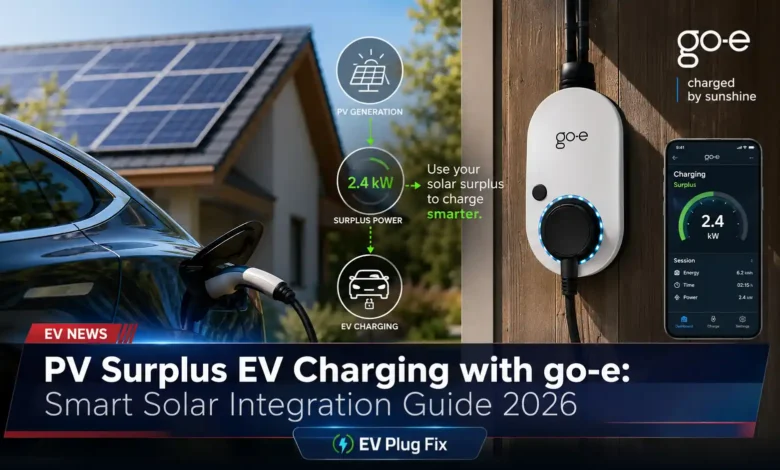
Solar energy is abundant, but capturing every free kilowatt-hour to power your electric vehicle requires more than just panels on your roof. The key lies in smart energy management, and for go-e charger owners, understanding PV surplus charging is the gateway to maximizing your solar investment. With electricity prices remaining volatile in 2026, the financial case for solar-optimized EV charging has never been stronger.
The principle is elegantly simple: instead of feeding excess solar energy back to the grid for a minimal feed-in tariff, you divert it to your EV battery. Given the widening gap between what you pay for grid electricity and what you earn from exporting solar, the savings are substantial. In markets like Germany, where the feed-in tariff can be as low as 8.2 cents per kWh versus a retail price of 38 cents per kWh, the benefit of self-consumption is massive.
This guide explores the two primary methods for achieving PV surplus charging with a go-e charger, explaining the technology, setup, and strategic considerations for 2026.
⚡ Key Takeaways: go-e PV Surplus Charging
- Maximum Solar Self-Consumption: Redirects excess rooftop solar energy (1.4 kW+) into your EV battery, avoiding cheap feed-in grid exports.
- Hardware Option (go-e Controller): Plug-and-play local Energy Management System using CT clamps that works with any PV inverter without cloud dependencies.
- Open Software Option (API/OCPP): Open local APIv2 and OCPP protocols integrate natively with Home Assistant, openWB, or EVCC for custom automations.
- Dynamic Phase Switching: Automatically switches between single-phase (low solar) and three-phase (high solar) charging to prevent session interrupts.
Key Takeaways
- PV surplus charging uses excess solar energy to power your EV, significantly reducing grid dependency and energy costs.
- The go-e Controller offers a seamless, proprietary solution for managing surplus energy without requiring advanced technical skills.
- Open EMS platforms provide flexibility and advanced features for tech-savvy users wanting to integrate their go-e charger into a broader smart home ecosystem.
- Minimum charging thresholds (around 1.4 kW) mean intelligent management is crucial to avoid interruptions on cloudy days.
Method 1: Using the Proprietary go-e Controller
For most homeowners, the most straightforward and reliable path to PV surplus charging is via the go-e Controller. This dedicated Energy Management System (EMS) is designed to work seamlessly with go-e chargers, offering a plug-and-play solution that doesn’t require programming skills or complex integrations.
The go-e Controller operates by using its own set of current transformers (CT clamps) to measure the total energy flow at the building’s grid connection point. This setup is independent of your inverter, making it compatible with virtually any PV system and AC battery storage solution. By continuously monitoring the grid feed-in or draw, the Controller determines the available surplus and communicates this data directly to the go-e charger via the local network (Wi-Fi).
In this configuration, neither the PV inverter nor a third-party smart meter actively participates in managing the charger. The go-e Controller acts as the central brain, ensuring the EV draws power only when there is genuine excess solar generation available after covering household consumption.
Important Note on Sensor Placement
To not only manage surplus but also accurately visualize total PV production, you must install an additional sensor around the inverter’s power supply cable. This is only possible for AC inverters and is crucial for monitoring system performance.
Setting Up PV Surplus Charging with go-e Controller
Configuration is managed through the go-e app, making the process user-friendly. Once the hardware is installed, you can activate PV surplus charging under the settings for “ECO Mode” or “Daily Trip Mode.” Simply enable the “Charge with PV surplus” slider. The app then allows you to fine-tune your preferences, such as activating automatic phase switching to maintain charging even during periods of lower PV output.
The go-e Controller also opens up advanced functionality, such as combining PV surplus charging with low-cost grid tariffs. In this scenario, the system prioritizes solar energy but intelligently switches to the grid during cheap-rate periods to top up the battery if needed. This hybrid approach ensures your EV is always ready to go while minimizing cost.
Method 2: Using an Open Third-Party EMS
For those who want more control or already have a specific home automation ecosystem, the go-e charger is an open book. Its open API (Application Programming Interface) allows it to be integrated with a wide range of third-party Energy Management Systems and home automation platforms like Home Assistant or openWB.
This method bypasses the go-e Controller, with an external system directly controlling the charger’s power output based on its own data and algorithms. For instance, an advanced setup might use an OCPP (Open Charge Point Protocol) back-end to send dynamic charging profiles to the charger. OCPP 2.0.1, for example, offers enhanced smart charging features such as local load balancing and better coordination with distributed energy resources.
The major advantage of an open EMS is its flexibility. It can be a more cost-effective solution if you already own a compatible system and have the technical know-how to configure it. It also enables deep integration with other smart home devices, allowing for complex energy optimization strategies based on real-time data from weather forecasts, dynamic grid tariffs, and even Vehicle-to-Grid (V2G) capabilities.
However, this approach requires a higher degree of technical expertise. As the go-e manual advises, you must often possess programming skills or confirm that the desired EMS has already integrated go-e chargers natively. For example, the ZewoDynamics EMS system requires you to enable the API v2 access on your go-e charger via its dedicated hotspot to allow third-party control.
Understanding the Technical Nuances
Regardless of the method chosen, the underlying principle for solar integration is the same: the charger must be capable of dynamically adjusting its power draw. This is where the concept of charging profiles comes into play. The EMS—whether go-e’s own Controller or a third-party system—continuously calculates the available surplus (PV generation minus household consumption) and sends a SetChargingProfile message to the charger.
This profile dictates the maximum charging current. As solar output fluctuates, the EMS updates the limit. A crucial constraint is the minimum charging current of the EV, typically around 6 amps (approximately 1.4 kW on a single-phase 230V system). If the surplus is below this threshold, the EMS must set the limit to zero, pausing the charge session.
This has significant practical implications. Systems that allow you to configure a “minimum PV share” can help mitigate this. For instance, setting a 50% solar share allows charging to start with only 700W of solar, drawing the remaining power from the grid, which is ideal for winter days with lower solar output.
Frequently Asked Questions: go-e PV Surplus Charging
What is the minimum solar power needed to start go-e surplus charging?
EV charging requires a minimum current of 6 Amps. On a single-phase 230V connection, this equals roughly 1.4 kW of solar surplus. On a three-phase connection, 6A equals roughly 4.2 kW of solar surplus.
Does the go-e Controller work with all solar inverter brands?
Yes. The go-e Controller uses physical CT measurement clamps directly at the grid connection point, making it 100% independent of inverter brands, battery systems, or solar panel hardware.
Can go-e chargers switch between 1-phase and 3-phase charging automatically?
Yes. Recent go-e Charger models (such as the Gemini series) feature automatic phase switching. This allows charging to start on 1-phase with just 1.4 kW solar surplus and scale up to 3-phase when solar output exceeds 4.2 kW.
Which Method is Right for You in 2026?
The best approach depends on your technical comfort level and desired functionality. For a turnkey, hassle-free experience that just works, the go-e Controller is the undisputed champion for most go-e owners. It provides all the necessary features to maximize self-consumption without the headache of scripting or complex network configuration.
If you are a tech enthusiast with a home automation system, or if you require a specific feature not offered by the go-e Controller (such as integrating with a specific dynamic tariff algorithm), then the open API approach is incredibly powerful. This method unlocks the full potential of the go-e charger as a fully integrated component of a modern, intelligent home energy ecosystem.
In either scenario, the benefits of pairing a go-e charger with PV are clear. You are not just charging your car; you are optimizing the most controllable load in your home to operate in harmony with your solar generation, saving money and reducing your reliance on the grid.