EV Charger Installation Cost 2026: The Hidden Expenses You Must Know Before Buying
Electric vehicles (EVs) are rapidly transforming global transportation. Millions of consumers are making the switch — drawn by lower fuel costs, reduced emissions, and government incentives. Yet the purchase price of the car is only the beginning. One of the most underestimated aspects of EV ownership is the true cost of home charging infrastructure.
This article examines the full spectrum of costs associated with purchasing an EV and installing a home charger — from the sticker price and electrical upgrades to permits, utility rate changes, and ongoing maintenance. It explores how these costs differ significantly across major regions: the United States, Europe, the United Kingdom, Canada, Australia, and China.
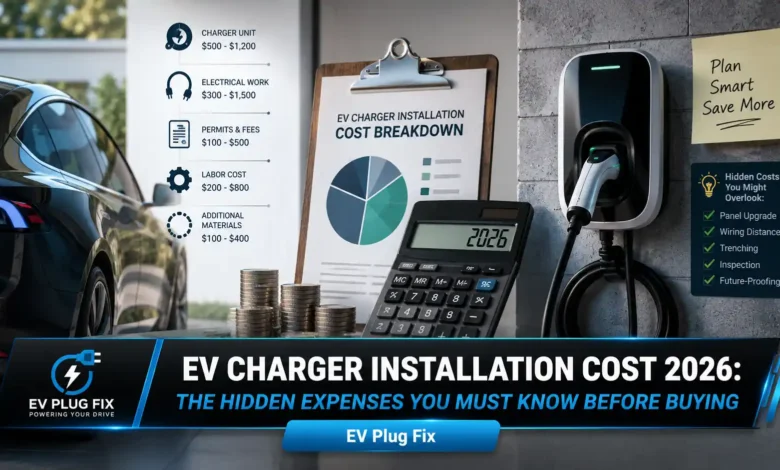
Key Takeaway: Studies consistently show that the total cost of EV charger installation can be 2–5x the cost of the charger unit itself, once labor, electrical work, and permitting are factored in.
Part 1: Buying an Electric Vehicle
1.1 Vehicle Purchase Price
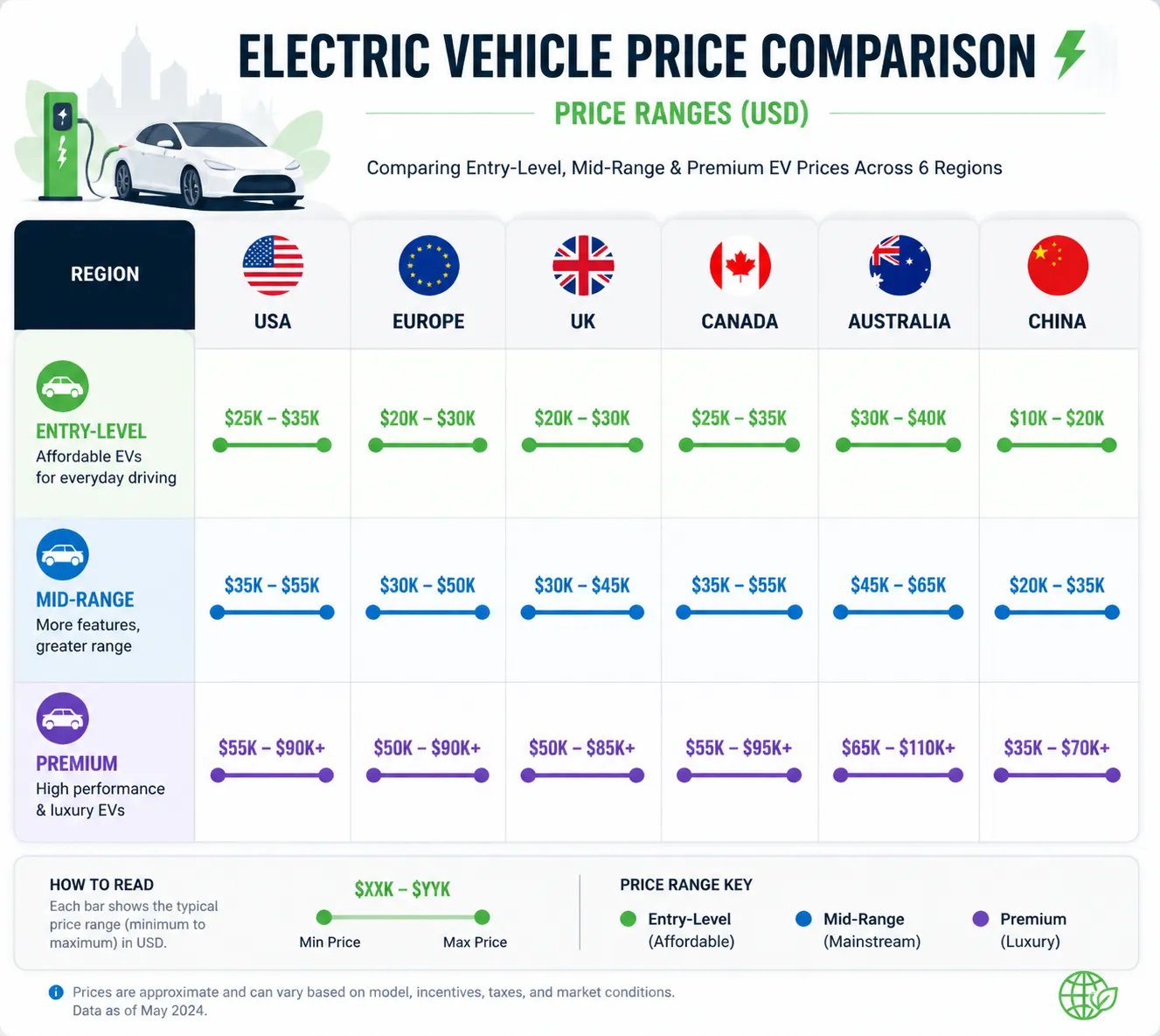
The upfront cost of an EV varies enormously by region, brand, and model. While battery costs have fallen dramatically, EVs still carry a premium over comparable ICE vehicles in most markets. The table below breaks down current price ranges across major global regions:
| Region | Entry-Level EV | Mid-Range EV | Premium EV |
|---|---|---|---|
| United States | $27,000 – $35,000 | $40,000 – $55,000 | $70,000+ |
| European Union | $30,000 – $42,000 | $45,000 – $60,000 | $75,000+ |
| United Kingdom | $30,000 – $40,000 | $44,000 – $58,000 | $72,000+ |
| Canada | $34,000 – $44,000 | $48,000 – $62,000 | $75,000+ |
| Australia | $38,000 – $50,000 | $55,000 – $70,000 | $85,000+ |
| China | $12,000 – $22,000 | $25,000 – $40,000 | $55,000+ |
1.2 Government Incentives & Tax Credits
Most governments offer purchase incentives that materially reduce the net cost of an EV. These programs differ in structure, eligibility, and value.
United States
- Federal Clean Vehicle Credit: Up to $7,500 for new EVs (subject to income limits and MSRP caps under the Inflation Reduction Act).
- Used EV Credit: Up to $4,000 for qualifying pre-owned EVs.
- State-level rebates: California offers up to $7,500 additional; other states range from $0 to $5,000.
European Union
- Country-by-country variation: Germany offers up to €3,000; France provides €5,000–€7,000 (means-tested); Norway has no purchase tax on EVs.
- VAT exemptions in some markets significantly lower the effective price.
United Kingdom
- The UK Plug-in Car Grant was phased out for private buyers in 2022; it still applies to vans, motorcycles, and taxis.
- Scotland offers an interest-free loan of up to £28,000 for EV purchases.
Canada
- Federal iZEV Program: Up to CAD $5,000 rebate on eligible EVs.
- Provincial programs stack on top: Quebec offers up to CAD $8,000; British Columbia up to CAD $4,000.
Australia
- Federal FBT exemption for EVs used as novated leases — significant savings for salary packaging.
- State-level rebates vary: NSW offers AUD $3,000; Victoria has wound down its program.
China
- Many national subsidies ended in 2022, but purchase tax exemptions remain, worth approximately CNY 10,000–30,000 depending on the vehicle.
Part 2: Understanding EV Charger Types
Before examining installation costs, it is essential to understand the three levels of EV charging:
| Level | Power Output | Charge Speed | Installation |
|---|---|---|---|
| Level 1 (AC) | 1.4 – 1.9 kW | 5–8 km per hour | Standard outlet, no install needed |
| Level 2 (AC) | 3.6 – 19.2 kW | 30–90 km per hour | Dedicated circuit + wall unit required |
| DC Fast Charging | 50 – 350 kW | 80% in 20–45 min | Not suitable for most homes |
For most homeowners, Level 2 charging is the practical target. It requires a dedicated 240V outlet (North America) or single/three-phase supply (Europe/Australia) and a professionally installed wall unit.
Part 3: Charger Hardware Costs
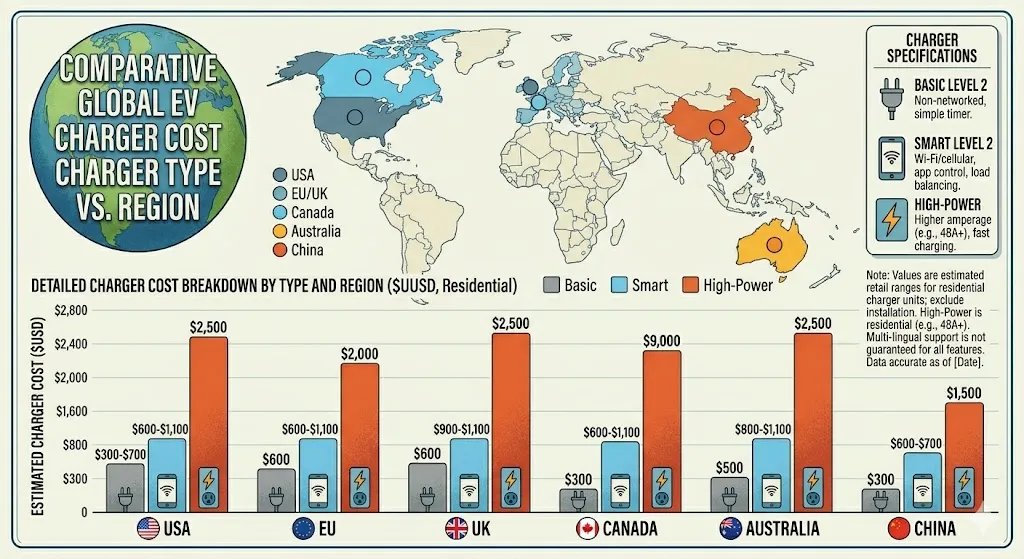
The charger hardware is just the first line item. Prices vary by brand, power output, and smart features such as Wi-Fi scheduling and load balancing.
| Charger Type | USA | EU/UK | Canada | Australia | China |
|---|---|---|---|---|---|
| Basic Level 2 (7.4kW) | $200–$400 | €300–€600 | CAD $250–$500 | AUD $400–$700 | CNY 1,500–3,000 |
| Smart Level 2 (7.4–11kW) | $400–$700 | €500–€900 | CAD $500–$800 | AUD $700–$1,200 | CNY 3,000–6,000 |
| High-Power (22kW+) | $700–$1,500 | €800–€1,500 | CAD $800–$1,600 | AUD $1,200–$2,500 | CNY 6,000–15,000 |
These are hardware-only costs. Installation, electrical upgrades, and permitting are additional and often exceed the charger cost itself.
Part 4: Installation Costs by Region
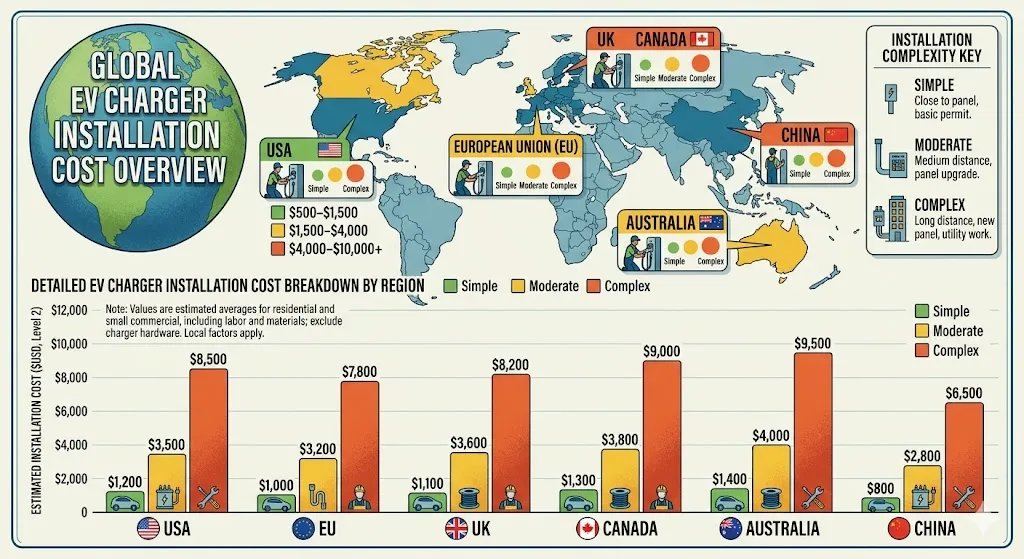
Installation expenses depend on your home’s existing electrical capacity, distance from the panel to the charger location, local labor rates, and permitting requirements.
4.1 United States
Licensed electrician labor ranges from $50–$130/hour, with major metro areas at the higher end.
- Simple installation (existing adequate panel, short cable run): $200–$500
- Moderate complexity (new dedicated circuit): $400–$800
- Complex installation (panel upgrade, long run, trenching): $1,500–$4,500+
Many older US homes have 100-amp or 150-amp panels — insufficient for a Level 2 charger alongside existing loads. A panel upgrade to 200 amps costs $1,500–$4,000. Permit costs range from $50–$250 with inspections adding 1–4 weeks. The 30% Federal Tax Credit (up to $1,000) applies to home charger installation.
4.2 European Union
Labor rates vary significantly: Germany and the Netherlands run €60–€100/hour; Eastern European countries run €20–€50/hour.
- Simple installation (adequate panel, indoor garage): €300–€600
- Moderate complexity (new circuit, outdoor installation): €500–€1,200
- Complex installation (three-phase upgrade, trenching): €1,500–€4,000+
A key advantage in many EU countries is wider availability of three-phase residential power, enabling 11kW or 22kW charging without major upgrades. France’s Advenir program subsidizes up to 50% of charger and installation costs (capped at €960 for individual homes).
4.3 United Kingdom
UK electrician rates average £45–£90/hour.
- Simple installation (modern consumer unit, garage): £250–£500
- Moderate complexity (new circuit, outdoor pod): £400–£800
- Complex installation (consumer unit upgrade, long cable run): £1,000–£2,500+
The OZEV EV chargepoint grant now targets renters, flat owners, and social housing tenants (up to £350 or 75% of cost). Since June 2022, all new home chargers must be ‘smart’ — capable of scheduling and demand-side response.
4.4 Canada
Canadian electrician rates vary by province: Ontario and BC run CAD $80–$130/hour; Prairie provinces are lower at CAD $60–$100/hour.
- Simple installation: CAD $300–$700
- Moderate complexity: CAD $600–$1,200
- Complex installation (panel upgrade, outdoor): CAD $1,500–$4,000+
Canada’s harsh winters add unique costs: EV batteries perform 20–40% worse in extreme cold, and installing conduit in frozen ground or through insulated walls adds expense. BC Hydro offers up to CAD $350 rebate; Hydro Quebec offers up to CAD $600.
4.5 Australia
Australia has high labor costs. Licensed electricians charge AUD $80–$150/hour. All EV charger installations must be performed by a licensed electrician — DIY installation is illegal.
- Simple installation (single-phase, existing circuit): AUD $500–$1,000
- Moderate complexity (new circuit, outdoor): AUD $900–$1,800
- Complex installation (three-phase, switchboard upgrade): AUD $2,000–$5,000+
Distribution network operators impose power limits. Installing a charger above 5kW may require a network application and infrastructure upgrades, adding AUD $500–$3,000. NSW offers a AUD $750 rebate for home charger installation.
4.6 China
Labor costs range from CNY 100–300/hour in major cities. However, over 70% of China’s urban population lives in apartments.
- Simple installation (dedicated parking space): CNY 800–2,000
- Moderate complexity (conduit run, smart meter): CNY 2,000–5,000
- Complex (new circuit, building management approval): CNY 5,000–15,000+
Installing a home charger requires approval from the property management company, and requests are commonly denied in older buildings. Many Chinese EV owners rely on public fast-charging networks, which are extensive and competitively priced. New residential buildings built after 2020 are required to include EV charging-ready infrastructure.
Part 5: Hidden Electrical Infrastructure Costs
5.1 Panel & Service Upgrades
One of the most commonly overlooked costs is the need to upgrade the home’s main electrical panel. Many homes — particularly those built before 1990 — do not have the capacity for a Level 2 charger alongside existing loads.
| Upgrade Type | USA | UK | EU (avg.) | Australia | Canada |
|---|---|---|---|---|---|
| Panel upgrade (100A → 200A) | $1,500–$4,000 | £1,000–£2,500 | €1,000–€3,000 | AUD $2,000–$5,000 | CAD $1,500–$4,000 |
| Service entrance upgrade | $1,000–$3,000 | £500–£2,000 | €500–€2,000 | AUD $1,500–$4,000 | CAD $1,000–$3,000 |
| Three-phase installation | N/A (rare) | £2,000–£5,000 | €1,500–€4,000 | AUD $3,000–$8,000 | CAD $3,000–$7,000 |
5.2 Wiring & Conduit Runs
The distance between the electrical panel and the desired charger location significantly affects cost. Key variables include:
- Indoor vs. outdoor installation (outdoor requires weatherproof conduit and fittings)
- Concrete or brick walls requiring drilling vs. accessible stud walls
- Underground trenching for detached garages (adds $500–$3,000 depending on distance)
- Fire-rated conduit required in some jurisdictions for multi-unit buildings
Part 6: Permits, Regulations & Compliance
| Region | Permit Required? | Typical Cost | Inspection? | Timeline |
|---|---|---|---|---|
| USA | Yes (most states) | $50–$250 | Yes | 1–4 weeks |
| EU | Varies by country | €0–€200 | Often not required | Immediate–2 weeks |
| UK | Yes (Part P) | £0–£150 | Yes (NICEIC/NAPIT) | 1–3 weeks |
| Canada | Yes (most provinces) | CAD $50–$300 | Yes | 2–6 weeks |
| Australia | Yes (state-dependent) | AUD $50–$300 | Yes | 1–4 weeks |
| China | Via property mgmt | CNY 0–500 | Utility inspection | Weeks to months |
HOA & Strata Restrictions
- USA: California and other states have ‘right to charge’ laws limiting HOA ability to deny EV charger installation.
- Australia: Strata owners must obtain special resolutions for electrical infrastructure changes under the Strata Schemes Management Act.
- China: Building management approval is mandatory; refusals are common in older buildings.
- UK & EU: Leasehold and shared-ownership properties often require freeholder consent.
Part 7: Ongoing Electricity Costs
| Region | Avg. Residential Rate | EV-Specific Rate? | Off-Peak Rate Example |
|---|---|---|---|
| USA | $0.13–$0.35/kWh | Yes (many utilities) | $0.07–$0.12/kWh |
| EU (Germany) | €0.28–€0.40/kWh | Yes (smart tariffs) | €0.15–€0.22/kWh |
| UK | £0.22–£0.30/kWh | Yes (Octopus Go, etc.) | £0.07–£0.12/kWh |
| Canada | CAD $0.09–$0.18/kWh | Yes (some provinces) | CAD $0.06–$0.10/kWh |
| Australia | AUD $0.25–$0.45/kWh | Limited | AUD $0.15–$0.25/kWh |
| China | CNY $0.50–$0.70/kWh | NEV tariffs available | CNY $0.25–$0.40/kWh |
Important: Many utilities impose demand charges — fees based on peak power draw in a billing period. Installing a high-power charger can add $20–$150/month to electricity bills. Smart chargers with scheduling can mitigate this by shifting charging to off-peak hours. Several utilities in the US, UK, and Australia offer dedicated EV tariffs with significant off-peak discounts.
Part 8: Total Cost Summary
Combining charger hardware, installation, and electrical upgrades, the following table provides indicative net costs (after rebates) for a typical mid-range EV owner:
| Cost Component | USA | UK | EU (avg.) | Canada | Australia | China |
|---|---|---|---|---|---|---|
| Charger Hardware | $400–700 | £400–700 | €500–900 | CAD 500–800 | AUD 700–1,200 | CNY 3,000–6,000 |
| Basic Installation | $300–800 | £300–700 | €400–1,000 | CAD 400–900 | AUD 700–1,500 | CNY 1,000–3,000 |
| Panel Upgrade (if needed) | $1,500–4,000 | £1,000–2,500 | €1,000–3,000 | CAD 1,500–4,000 | AUD 2,000–5,000 | CNY 3,000–8,000 |
| Permits & Inspections | $50–250 | £0–150 | €0–200 | CAD 50–300 | AUD 50–300 | CNY 0–500 |
| Less: Rebates/Credits | -$1,000–2,000 | -£0–350 | -€500–1,500 | -CAD 350–1,000 | -AUD 500–1,500 | -CNY 500–2,000 |
| NET TOTAL (typical) | $1,000–$3,750 | £700–$3,700 | €400–$3,600 | CAD $1,100–$5,000 | AUD $950–$6,500 | CNY $2,500–$15,500 |
Panel upgrades affect roughly 30–40% of US/Canadian/Australian homeowners and up to 60% of UK homeowners with older properties. Actual costs depend on property specifics.
Part 9: How to Minimize Hidden Costs
Before You Buy the Car
- Check your home’s electrical capacity with a licensed electrician before choosing a charger power level.
- Research your utility’s EV rate — sign up for a time-of-use or dedicated EV tariff before installation.
- Verify all available rebates at the federal, state/provincial, and utility level — they change frequently.
During Installation
- Get at least three quotes from licensed electricians with EV charging experience.
- Bundle with other electrical work (panel upgrade, solar install) to save on mobilization costs.
- Ask about ‘make-ready’ installation: running conduit now and adding the charger later can save money.
- Ensure your installer pulls the required permit — unpermitted work may void home insurance.
After Installation
- Schedule charging during off-peak hours using the charger’s app or smart home integration.
- Monitor charging data to track electricity costs and detect anomalies.
- Consider solar and home battery integration to reduce grid dependence.
“The key takeaway is to investigate thoroughly before you buy the vehicle. Consult a licensed electrician, contact your utility, and research all available incentives in your region. The savings from an EV’s lower fuel and maintenance costs are real — but they compound most powerfully when the charging infrastructure is set up cost-effectively from the start.”
Conclusion
The question ‘Are there hidden costs in installing an EV charger?’ has a clear answer: yes — but the magnitude varies enormously by location, home type, electrical infrastructure, and available incentives.
For a US homeowner in a newer suburb with a 200-amp panel and an attached garage, the net cost after federal tax credits might be as low as $500–$800. For an Australian apartment dweller in an older building, the total could exceed AUD $8,000. For a Chinese urbanite, public charging may be the only practical option.
The key takeaway is to investigate thoroughly before you buy the vehicle. Consult a licensed electrician, contact your utility, and research all available incentives in your region. The savings from an EV’s lower fuel and maintenance costs are real — but they compound most powerfully when the charging infrastructure is set up cost-effectively from the start.
Disclaimer: Costs, incentives, and regulations change frequently. Always verify current figures with local authorities, utilities, and licensed contractors before making financial decisions.