Level 2 Home EV Charger Installation Cost 2026: Real Prices & Savings
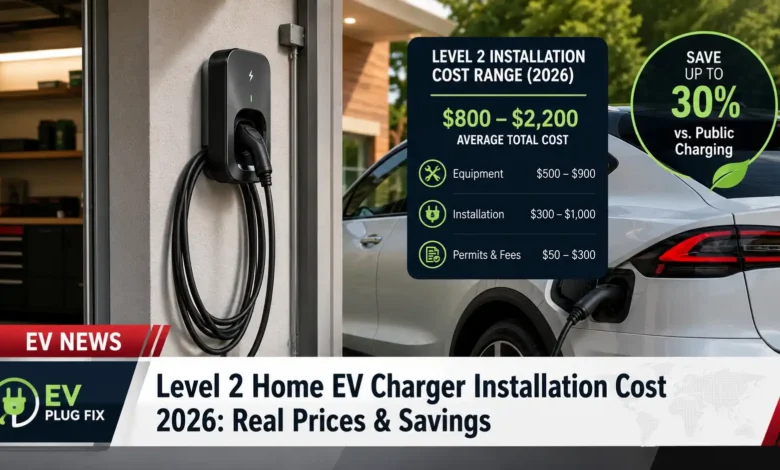
Level 2 home EV charger installation cost in 2026 typically ranges between $800 and $3,500 total, covering hardware, professional labor, wiring, permits, and any necessary electrical panel upgrades. Basic installations with adequate panel capacity often stay under $1,500, while older homes requiring electrical service upgrades can push expenses toward the higher end — though federal and state incentives frequently reduce net costs by 30% to 60%.
Imagine unboxing your new electric vehicle, excitement building, only to face the reality of home charging expenses that stretch far beyond the charger itself. Many homeowners experience that moment of sticker shock when installation quotes arrive. Having guided countless EV owners through this process as General Manager at XIAMEN PARWATT NEW ENERGY TECHNOLOGY CO.,LTD, I’ve watched the same questions surface repeatedly — and I’ve seen how proper planning transforms a potentially stressful investment into a smooth, budget-friendly upgrade.
Why Most Homeowners Get Shocked by Real Level 2 Charger Installation Costs
You research charger prices online, see a $400 unit, and mentally budget $600 total. Then electricians start quoting $1,800, $2,500, or more. The disconnect happens because the charger itself represents only 20-30% of the total project cost in most residential installations.
Electrical panel capacity remains the biggest variable. Homes constructed before 2000 typically have 100-amp or 150-amp panels, while modern Level 2 charging demands 30-50 amps of dedicated capacity. When your panel lacks headroom, upgrading to 200-amp service becomes necessary — and that alone runs $1,500 to $4,000 depending on your location and existing infrastructure. Understanding EV Charging Speed Factors helps clarify why amperage matters so much for your daily driving needs.
Wiring distance creates another cost multiplier. Every foot from your main panel to the garage adds material and labor expense. Short 10-foot runs may add only $200-300, but garages located 50 feet or more from the panel frequently require $800-$1,500 in additional wiring, conduit, and labor. Through finished walls or underground paths? Expect those numbers to climb further.
Permits and inspections represent another expense homeowners frequently overlook. Municipalities require electrical permits for new circuits, with fees ranging from $100 to $500. While skipping this step might save money upfront, unpermitted work can void insurance coverage, complicate home sales, and create code violation headaches later. Review Home EV Charger Permits to understand local compliance requirements before starting your project.
Hidden Cost Factors That Catch Buyers Off Guard
- Panel load calculations — Professional assessment reveals whether your existing service supports EV charging without upgrades
- Labor rates by region — Electrician charges vary from $75/hour in rural areas to $200/hour in major metropolitan markets
- Material price fluctuations — Copper wiring costs remain elevated in 2026 due to ongoing supply chain adjustments
- Subpanel requirements — Detached garages often need separate subpanels, adding $500-$1,000 to projects
- Smart charger infrastructure — Wi-Fi connectivity and load management features may require additional network setup
| Cost Factor | Typical Range | Why Homeowners Miss It |
|---|---|---|
| Electrical Panel Upgrade | $1,500 – $4,000 | Most buyers assume existing panels handle the load |
| Long Wiring Runs | $500 – $1,500 | Garage distance from panel often overlooked |
| Permits & Inspections | $100 – $500 | Not included in equipment pricing |
| Conduit & Materials | $200 – $600 | Breakers, wiring, mounting hardware add up |
| Subpanel Installation | $500 – $1,000 | Detached garages require separate distribution |
One customer in 2025 illustrates these dynamics perfectly. He allocated $600 for his charger, confidently planning a simple install. His 100-amp panel couldn’t support the additional load, and his garage sat 60 feet from the electrical room. The final bill: $3,200 — nearly six times his original estimate. Avoid this by starting with a comprehensive site assessment.
7 Common Misconceptions About Level 2 EV Charger Installation Costs
The internet offers plenty of advice about EV charging, but much of it oversimplifies real-world installation complexity. Let’s separate fact from fiction.
Misconception #1: “The charger price equals total cost.” This remains the most damaging assumption. Quality Level 2 units cost $300-$800, but installation typically doubles or triples that figure. Hardware represents just one component of a complete system.
Misconception #2: “DIY installation saves the most money.” While some homeowners successfully install their own chargers, electrical work carries serious safety implications. Mistakes create fire hazards, void equipment warranties, and fail inspection. Most manufacturers require professional installation for warranty validity. The $500-$1,000 saved on labor isn’t worth the risk.
Misconception #3: “All installations cost roughly the same.” Geographic variation runs deep. A San Francisco installation might cost 75% more than one in rural Ohio due to labor rates, permitting requirements, and local code enforcement. Always benchmark against local pricing.
Misconception #4: “Incentives cover everything.” Government programs provide meaningful support but rarely eliminate all costs. The federal 30C tax credit offers up to $1,000, and state programs add more — but these reduce net costs rather than eliminating them entirely. Expect to pay something out of pocket.
| Common Misconception | Reality Check | Cost Impact |
|---|---|---|
| Charger price = total project cost | Installation adds significant expenses | Can triple your budget |
| DIY installation is always cheaper | Safety risks, code issues, warranty voids | Potential rework costs |
| Incentives eliminate out-of-pocket costs | Credits and rebates reduce but don’t eliminate | Net 30-60% savings typical |
| Every home requires the same work | Panel age, capacity, garage location vary | $800-$3,500+ range |
| All electricians charge similar rates | Regional differences are substantial | 50-100% variation possible |
Misconception #5: “Faster chargers cost more to install.” Higher-power units (19.2kW vs. 7.7kW) may require heavier wiring and larger breakers, but the installation difference is often modest compared to panel capacity requirements. Your limiting factor is almost always your home’s electrical service, not the charger’s maximum output.
Misconception #6: “Once installed, costs are fixed.” Ongoing electricity costs vary significantly based on when you charge. Time-of-use rates can double your per-kWh cost during peak hours. Smart scheduling through OCPP-compliant chargers optimizes this, potentially saving $200-$400 annually. Learn more about EV Time-of-Use Plans to maximize your charging savings.
Misconception #7: “Future-proofing requires expensive upgrades now.” While installing extra capacity makes sense, load management technology offers an alternative. Devices that intelligently balance household and EV charging can postpone or eliminate panel upgrades entirely.
2026 Level 2 Home EV Charger Installation: Complete Cost Breakdown
Understanding each cost component puts you in control of your budget. Here’s what every element contributes to the final number in 2026.
Charger Hardware ($300-$800): The device itself. Basic units provide reliable charging without connectivity. Smart chargers add Wi-Fi, app control, scheduling, and load management — features that deliver ongoing savings despite modestly higher upfront prices. Our EP02 Portable EV Charger with Display offers clear performance metrics for budget-conscious buyers.
Professional Labor ($500-$1,500): Licensed electricians handle the complete installation — mounting the unit, running wiring, installing breakers, and verifying proper operation. Experienced EV charger installers command premium rates but complete work faster and more reliably than general electricians unfamiliar with EV-specific requirements.
Wiring and Materials ($200-$600): Copper conductors, conduit, mounting brackets, and circuit breakers. Quality materials ensure safety and longevity. Cutting corners here risks overheating and premature failure.
Electrical Panel Upgrade ($1,500-$4,000): The costliest variable. Upgrading from 100-amp or 150-amp to 200-amp service provides capacity for EV charging and future home additions. Scope includes new panel, main breaker, meter coordination, and utility involvement.
Permits and Inspection ($100-$500): Municipal requirements vary widely. Some cities process permits quickly; others require detailed plans and multiple inspections. Factor these into your timeline and budget.
Real-World Installation Examples
- Basic Install — $800-$1,200: Attached garage, adequate panel capacity (200-amp service), short wiring run (under 20 feet), simple mounting. Most new homes fit this category.
- Moderate Install — $1,500-$2,500: Detached garage with 30-50 foot run, some panel capacity concerns (150-amp service), modest permitting requirements. Older homes with recent electrical updates typically fall here.
- Complex Install — $2,500-$5,000+: Older home (100-amp panel requiring upgrade), long wiring runs (60+ feet), subpanel needed, strict local codes. Pre-1990 homes often require this level of work.
| Component | Low-End Cost | High-End Cost | Key Cost Drivers |
|---|---|---|---|
| Charger Hardware | $300 | $800 | Smart features, amperage rating, connectivity |
| Labor & Installation | $500 | $1,500 | Complexity, local rates, experience level |
| Wiring & Conduit | $200 | $600 | Distance from panel, wall construction |
| Panel Upgrade | $1,500 | $4,000 | Existing service size, utility coordination |
| Permits & Inspections | $100 | $500 | Local municipal requirements |
| Subpanel (if needed) | $500 | $1,000 | Detached garage or distance needs |
| Total Before Incentives | $800 | $3,500+ | Average: $1,800-$2,500 |
“The single biggest money-saving step is getting a load calculation before you do anything else. At Parwatt, we’ve seen load management technology eliminate the need for panel upgrades in 40% of homes that initially thought they needed them.”
— Jacky Huang, General Manager, Parwatt
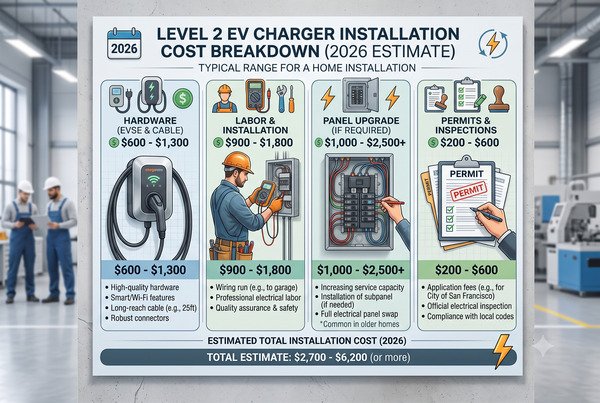
Upgrading your electrical panel is often the biggest cost factor in Level 2 charger installation
Smart Strategies to Reduce Level 2 Charger Installation Costs Without Sacrificing Quality
Savvy homeowners leverage several strategies to minimize expenses while ensuring safe, reliable charging. Here’s how to optimize your investment.
Get Professional Load Calculation First: This $100-$200 assessment reveals your home’s true electrical capacity. Many homeowners discover they don’t need a full panel upgrade — load management technology can dynamically balance household and EV charging demands. Our EC01 Wall Charger includes built-in load management that reduces electrical service requirements by up to 40%.
Stack Incentives Aggressively: Multiple programs often overlap in 2026. Combine the federal 30C tax credit (30% up to $1,000) with state rebates ($500-$2,000 in many states) and utility incentives (often $300-$500 for charger purchases and installation). Some programs also cover panel upgrades specifically. Check your utility’s website for current offerings.
Consider Portable Options for Temporary Needs: If you’re renting, testing EV ownership, or planning a move, portable Level 2 chargers like our EP01 offer flexibility without permanent installation costs. These units plug into existing 240V outlets (like dryer receptacles) and deliver reliable charging without hardwiring expenses.
Choose Smart Chargers Over Basic Units: While smart chargers cost $100-$200 more upfront, they deliver ongoing savings through off-peak charging optimization. Scheduling charging during lowest electricity rates saves $100-$300 annually. The payback period typically runs 12-18 months, making smart chargers the more economical choice for most homeowners.
Get Multiple Quotes: Three to five quotes from licensed electricians reveal market pricing. Look for electricians with specific EV charger certification and ask about their experience with your home type. Detail your requirements clearly to ensure apples-to-apples comparisons.
Action Steps for Immediate Savings
📋 Assessment Phase
- Schedule professional load calculation
- Measure garage-to-panel distance
- Research local permit requirements
- Check utility incentive programs
💰 Financial Planning
- Apply for all available rebates
- Time installation with tax year
- Explore utility financing options
- Consider energy audit programs
🔧 Installation Preparation
- Get 3+ licensed electrician quotes
- Verify EV-specific experience
- Request detailed itemized bids
- Schedule during off-peak seasons
Bundle with Other Electrical Work: If you’re already planning other home electrical projects — kitchen upgrades, solar installation, or basement finishing — bundle the charger installation. Electricians often reduce rates for combined work since travel and permitting costs spread across multiple projects.
Choose OCPP-Compliant Chargers: Open Charge Point Protocol compatibility ensures your charger works with multiple apps and utility demand response programs. Many utilities offer additional incentives for OCPP-compliant devices that can be managed remotely to balance grid demand. Understanding EV Charging Data Standards helps you select equipment that provides accurate consumption information for maximum savings.
Time Your Purchase: Many manufacturers and retailers offer seasonal promotions. Q4 often brings holiday discounts, while Q2 may feature new model releases with previous-generation units at reduced prices. Combine these with incentive timing for maximum savings.
Your Step-by-Step Installation Timeline for 2026
Moving from decision to charging typically takes 3-4 weeks when following this proven process. Here’s what to expect at each stage.
Week 1: Assessment Phase
Schedule electrical load calculation, measure distances, research local incentive programs, and contact three electricians for preliminary quotes. Document your home’s current panel specifications and photograph the installation location.
Week 2: Planning and Approval
Select your electrician, finalize charger choice, submit permit applications, and complete incentive applications. Order your charger once permits are approved to ensure delivery aligns with installation scheduling.
Week 3: Installation and Inspection
Professional installation takes 4-8 hours for standard installations. Schedule inspection promptly after work completes. Some electricians handle inspection coordination; confirm this during selection. Level 2 EV Installation typically follows this timeline, though complex projects may extend into week four.
Week 4: Activation and Optimization
Configure your charger’s smart features, set up scheduling preferences, test charging with your vehicle, and register with any applicable utility programs. Monitor your first few charges to verify proper operation.
| Phase | Duration | Critical Actions | Red Flags |
|---|---|---|---|
| Assessment | Week 1 | Load calc, measure distance, research incentives | Single electrician quote, skipping permit research |
| Planning | Weeks 1-2 | Select charger, apply for permits and incentives | Delaying incentive applications |
| Purchasing | Week 2 | Order charger, verify delivery dates | Assuming hardware includes installation |
| Installation | Weeks 3-4 | Professional work, inspection, testing | DIY shortcuts, unlicensed work |
| Optimization | Week 4+ | Configure smart features, monitor performance | Not using scheduling features |
Frequently Asked Questions About Level 2 EV Charger Installation Costs
How much does a Level 2 EV charger installation really cost in 2026?
Total costs range from $800 to $3,500+, with the average homeowner paying approximately $1,800-$2,500 before incentives. After applying available federal and state incentives, net costs typically fall between $1,000 and $1,800.
What factors increase home EV charger installation costs most significantly?
Electrical panel upgrades represent the largest variable, followed by long wiring runs from panel to installation location. Labor rates in your region and permit complexity also influence final costs substantially.
Do I need an electrical panel upgrade for a Level 2 charger?
Not always — homes with 200-amp service usually handle Level 2 charging without upgrades. Homes with 100-amp or 150-amp service may require upgrades, but load management technology can sometimes eliminate this need. A professional load calculation provides the definitive answer. EV Charging Efficiency also depends on proper panel sizing for optimal performance.
How much can government incentives reduce installation costs?
Combined federal, state, and utility incentives typically reduce net costs by 30-60%. The federal 30C tax credit offers up to $1,000, while state programs add varying amounts. Many homeowners pay $500-$1,500 less than sticker price after applying all available incentives.
Is it cheaper to install a Level 2 charger myself?
While DIY installation saves labor costs, it risks safety issues, code violations, and warranty voiding. Most manufacturers require professional installation for warranty coverage. Professional installation also ensures proper permitting and inspection — critical for insurance and home resale.
What’s the average payback period for a home Level 2 charger?
Most homeowners recover their investment in 2-4 years through convenience, lower per-mile electricity costs compared to public charging, and increased vehicle utility. Homes using off-peak charging schedules see even faster returns.
Can I install a Level 2 charger without permits?
Technically possible but strongly discouraged. Unpermitted work creates insurance risks, complicates home sales, and may result in fines. Most municipal codes require permits for new 240V circuits — this isn’t optional for code-compliant installations.
How does home charging compare to public charging costs?
Home charging typically costs 40-60% less per mile than public DC fast charging. At average electricity rates of $0.15/kWh, home charging costs approximately $0.04 per mile versus $0.20-$0.30 per mile at public stations. These savings quickly accumulate — typical drivers save $500-$1,000 annually by charging at home.
What should I look for when choosing an electrician?
Seek licensed electricians with specific EV charger certification and verifiable experience. Request references from recent EV installations. Ensure they handle permitting, inspection coordination, and warranty registration. Compare itemized quotes carefully — lowest price doesn’t always mean best value.
Are there financing options for EV charger installation?
Many utilities offer low-interest loans or on-bill financing for charging infrastructure. Some states provide subsidized financing programs. Manufacturer financing options also exist for qualifying hardware purchases. Explore all options to spread costs over manageable monthly payments.
Ready to Power Your EV Journey in 2026?
Installing a Level 2 home EV charger represents one of the smartest investments in your electric vehicle ownership experience. While costs range from $800 to $3,500+, proper planning, aggressive incentive use, and smart technology choices consistently reduce net expenses while delivering reliable, convenient charging for years to come.
Start your journey today with a professional electrical assessment. Understand your home’s capacity before making commitments. Research available incentives in your area — they vary significantly by state and utility. And choose quality hardware that supports OCPP compliance, load management, and smart scheduling features that maximize long-term savings.
At Parwatt, we’ve helped thousands of homeowners, fleet operators, and businesses navigate this process successfully. Our EC01 Wall Charger and EP01 Portable EV Charger deliver the reliability, intelligence, and flexibility modern EV owners demand. Whether you’re preparing for your first electric vehicle or expanding charging capacity for multiple EVs, proper installation planning ensures your home charging experience meets expectations without budget surprises.
The future of mobility is electric — and home charging is the foundation of that future. Install smart, save effectively, and enjoy the convenience of waking up to a charged vehicle every morning.