§14a EnWG Germany EV Charger Rules 2026: Compliance & Smart Charging
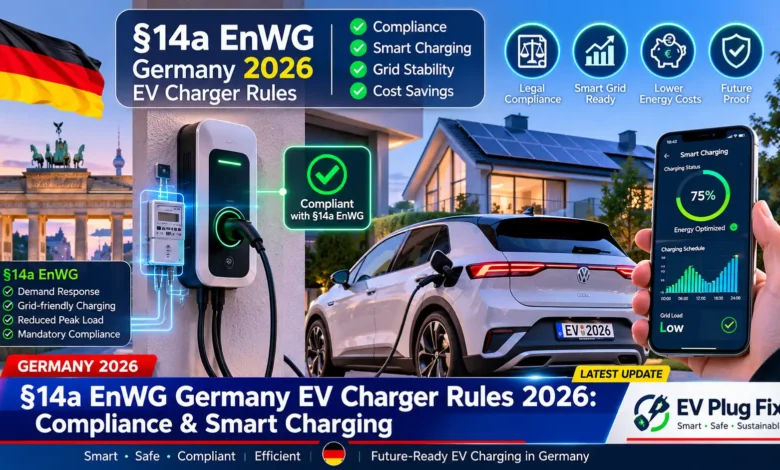
§14a EnWG EV charger installation rules are now mandatory for all new wallboxes in Germany, reshaping how homeowners and businesses approach electric vehicle charging. Since January 1, 2024, the updated Energy Industry Act requires that any newly installed EV charging station with a nominal output exceeding 4.2 kW must be controllable by the Distribution System Operator (DSO) to prevent grid overloads . This regulation marks a fundamental shift in EV infrastructure, prioritizing grid stability by giving operators the ability to temporarily manage high-power devices like wallboxes and heat pumps . For a complete understanding of how these requirements integrate with modern charging systems, explore our §14a EnWG Compliance Guide.
Understanding §14a EnWG: The Grid Control Mandate
The core of §14a EnWG is simple: new, powerful electrical devices must be “grid-friendly” . The DSO can temporarily reduce the charging current of your wallbox when the local grid is under heavy strain from numerous appliances like heat pumps or other chargers . This isn’t a total shutdown. The regulation mandates that you retain a minimum of 4.2 kW of charging power, ensuring you can still add roughly 50 kilometers of range within a two-hour period . Understanding EV Charging Time dynamics helps you plan your charging schedule effectively even during grid control events.
The rule applies to all “controllable consumer devices” with a connection capacity of over 4.2 kW that are connected to the low-voltage network . This includes:
- Private EV charging points (wallboxes)
- Heat pumps, including their supplementary heating elements
- Cooling systems used for air conditioning
- Battery storage systems, though only the charging process from the grid is affected, not PV surplus or discharging .
How Grid Operators Control Your EV Charger
Grid operators achieve this control primarily through a ripple control receiver (RCR) or an FNN control box installed at your property . This device interprets the grid operator’s signals and communicates with your wallbox to manage its power consumption . Modern wallboxes can connect to these systems via various methods, including relay circuits, EEBUS (an IP-based standard), or OCPP for cloud-based management . For properties with multiple EVs, our Multi-EV Home Charging guide offers additional insights on managing load distribution effectively.
Your electrician plays a crucial role in this process. They are responsible for ensuring your wallbox is installed with the correct control receiver and meets your local grid operator’s technical connection requirements (TAB) . Without this grid-compatible control, you cannot register your charging station with the grid operator, and it cannot be formally authorized or put into operation. The process is also changing: from 2026 onwards, DSOs must provide clear and transparent information on the status of grid connection requests for EV charging points, with standard processes being introduced .
“The goal of this netzdienliche Steuerung is to protect the power grid from overloads and ensure security of supply during the energy transition.”
Your Compensation for Grid Controllability
The regulation is a two-way street. By allowing your grid operator to manage your EV charger, you are entitled to a significant reduction in your network fees, which shows up as a discount on your electricity bill . You have three compensation options to choose from when you register your device :
- Annual Flat-Rate Discount: Receive a fixed reduction ranging from 110 to 190 euros, depending on your network area.
- Percentage Reduction: Get a 60% reduction on the working price (kilowatt-hour cost). This requires a separate meter for the controllable device.
- Combined Model (from 2025): Combine the flat-rate discount with a time-variable network fee, which fluctuates based on grid load, incentivizing you to charge during off-peak hours .
For New Installations (Post Jan 1, 2024)
- Must be fully compliant and controllable upon installation.
- Apply for compensation with your grid operator to receive reduced network fees.
- You will need to pay for the connection of your devices to the control technology .
For Existing Installations (Pre Jan 1, 2024)
- Exempt from the new rules unless you had a prior agreement with the grid operator.
- Existing agreements remain valid until December 31, 2028 .
- You may voluntarily switch to the new, compensated model, but this decision is irreversible .
Preparing for the Future: 2026 Rule Changes and V2G
The regulatory landscape continues to evolve. A major reform passed in November 2025 is set to unlock the full potential of bidirectional charging in Germany, starting in 2026 . For a deeper comparison of charging technologies, our EV Charging Levels Guide provides valuable context on how different power levels affect your charging strategy.
| Timeline | Regulatory Change | Impact on EV Owners |
|---|---|---|
| January 1, 2024 | §14a EnWG takes effect. | New wallboxes must be controllable. |
| January 1, 2026 | Grid-fee relief for V2G begins. | No more double fees for feeding stored electricity back into the grid . |
| April 1, 2026 | MiSpeL process rules take effect. | Simplifies technical and billing processes for V2G; no second meter needed . |
These changes are monumental, as they remove the final barrier to making Vehicle-to-Grid (V2G) an economically viable technology in Germany. By treating EV batteries like stationary storage devices, the reform unlocks an estimated 3.3 to 5.0 GWh of decentralized storage capacity—comparable to a large power plant . For consumers, this means your electric vehicle can evolve from a simple mode of transport to a mobile, income-generating energy asset. Proper EV Charger Circuit Breaker installation ensures your system can handle these advanced bidirectional capabilities safely.
However, the rollout depends on faster smart meter adoption, as only about 3% of households are currently equipped with the necessary intelligent metering systems . Learn more about smart charging management with our go-e Load Management guide to optimize your setup for future requirements.
FAQ: Your Key Questions Answered
Will my grid operator definitely control my charger?
It’s uncertain. The barrier for operators to actually exercise this control is high, as it incurs significant additional costs and administrative requirements . Many experts believe most grid operators will shy away from control measures in the coming years, but the technical capability must be in place.
What happens to my charging session when the grid is overloaded?
Your charging speed is reduced to a minimum of 4.2 kW. Your car will continue charging, just more slowly. The operator can only control for a maximum of two hours per day under normal circumstances .
Can I install a wallbox myself?
No. The installation must be performed by a qualified electrician who can ensure the device is configured to meet the DSO’s specific technical requirements and can properly set up the ripple control receiver . For expert guidance on professional installation, refer to our Austria Wallbox Installation resource, which covers similar regulatory frameworks.
What is a “controllable consumer device”?
It refers to a high-power electrical appliance (over 4.2 kW) that can be remotely managed by the grid operator to prevent grid overloads. This includes wallboxes, heat pumps, and electrical storage systems .