§14a EnWG Compliance 2026: go-e Charger Gemini Setup & Steuerbox Options
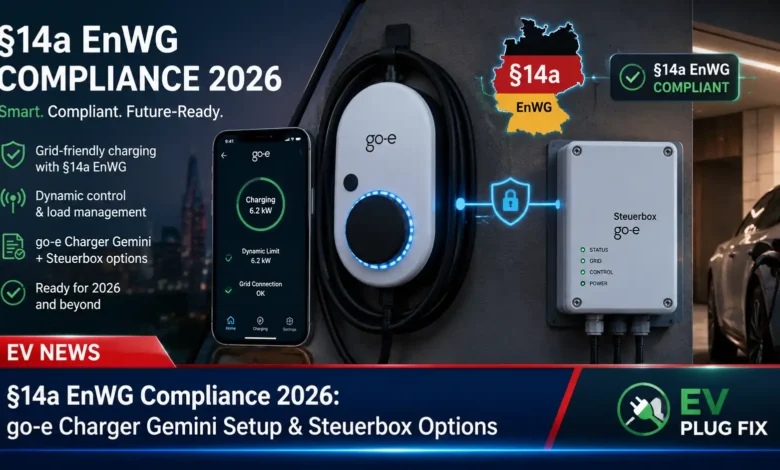
German §14a EnWG regulations have reshaped the landscape for EV charging in 2026, making it crucial for owners of the go-e Charger Gemini to understand their compliance pathways. Whether you own the stationary Gemini or the mobile Gemini flex, navigating the requirements for a Steuerbox, ripple control receiver, or alternative control methods is essential for grid stability and legal operation. Before installing any system, it’s wise to understand Home EV Charger Permits in your area to ensure full legal compliance from the start. With the law taking full effect in 2024 and evolving into 2026, EV drivers need clear, actionable guidance to ensure their setup meets the latest standards. Let’s explore the best strategies to keep your go-e Charger Gemini series compliant, future-proof, and ready for the road ahead.
📢 Important Notice: As of January 1, 2024, all newly installed EV charging points in Germany must comply with §14a EnWG, enabling grid operators to reduce charging capacity during peak loads. The go-e Charger Gemini series offers versatile solutions to meet this mandate.
Understanding §14a EnWG and Your go-e Charger Gemini
The Energiewirtschaftsgesetz (EnWG) §14a empowers network operators to manage grid stress by temporarily reducing the charging capacity of controllable consumer devices, including wallboxes. The go-e Charger Gemini, a market leader in home charging, provides multiple pathways to achieve this compliance for both its stationary and mobile flex variants. For those considering different form factors, comparing Wall-Mounted EV Chargers against pedestal options can help determine the best installation approach for your property.
Compliance is not a one-size-fits-all scenario. Your choice depends on your existing electrical infrastructure, the capabilities of your network operator, and your personal preferences for control and convenience. The go-e Charger Gemini flex, in particular, has been highlighted as a future-proof choice due to its multiple control options, making it compatible with virtually all German network operators.
The Three Primary Control Options
To comply with the network operator’s ability to regulate your EV charging, you can implement one of the following control strategies, suitable for both the stationary and mobile go-e Charger Gemini models:
- Control via Modbus TCP using a PLC (Programmable Logic Controller)
- Contactor circuit connection to the network operator’s Steuerbox or ripple control receiver
- OCPP (Open Charge Point Protocol) interface managed by the grid operator
Each method offers distinct advantages and technical requirements. Let’s break them down to help you make the right decision for your 2026 EV setup. Understanding the OCPP Charging Protocol is particularly valuable since it forms the backbone of the most future-proof compliance option available.
Option 1: Direct Hardwired Control
The stationary go-e Charger Gemini features a dedicated data cable with red and white signal wires designed for a potential-free connection. Your certified electrician can hardwire this to the output of a Steuerbox or ripple control receiver provided by the network operator.
When the grid reaches peak load, the operator sends a signal through the Steuerbox. This potential-free contact closure tells the Gemini to reduce its charging current or, in some cases, shut down completely. This method provides a direct, physical link for grid control and is often the most straightforward solution for the stationary Gemini.
| Control Method | Suitable For | Key Feature | Pros | Cons |
|---|---|---|---|---|
| Hardwired Steuerbox | Stationary Gemini | Red/White signal wire connection | Direct physical control, Simple integration | Only full shutdown possible, Not for Gemini flex |
| Modbus TCP via PLC | Gemini & Gemini flex | Network-based communication | No potential-free input required, Flexible integration | Requires network setup & PLC |
| OCPP Interface | Gemini & Gemini flex | Open Charge Point Protocol | Scalable, Future-proof, supports many operators | Requires operator OCPP URL |
Option 2: Contactor Circuit with Steuerbox or Ripple Control Receiver
This approach involves a contactor, such as an ABB ESB 40-40, wired between your electrical supply and the go-e Charger Gemini. The contactor is controlled by the potential-free output of the network operator’s Steuerbox.
In the event of a grid overload, the operator activates the Steuerbox, which energizes the contactor, completely cutting the power supply to the wallbox. This effectively halts the charging process entirely, allowing the grid to stabilize. For homeowners exploring cost-effective solutions, understanding Level 2 Charger Installation Cost can help budget for the necessary hardware and electrician services.
⚠️ This is the only variant where charging current cannot be reduced; it only allows a complete shutdown during a grid overload. While effective, it lacks the nuance of power reduction offered by other methods.
Despite this limitation, a contactor circuit remains a robust and reliable option, especially for setups where a simple on/off control is acceptable. Importantly, all settings and authentications on the go-e Charger are preserved even after a power interruption, so when power is restored, the charger seamlessly resumes its previous state.
Option 3: Modbus TCP for Advanced Network Control
The Modbus TCP communication protocol enables network-based control of the go-e Charger, making it particularly valuable for the mobile Gemini flex, which lacks a potential-free input. This method uses a PLC to send control signals over your local network to the charger, allowing the network operator to modulate the charging power.
This is a highly flexible and scalable solution, as it integrates well with existing smart home systems and energy management platforms. It allows for more granular control than a simple on/off contactor, enabling dynamic load management based on real-time grid conditions. Combining this with Smart EV Energy Management can optimize your entire home’s power usage across multiple devices.
For go-e Charger Gemini flex owners, Modbus TCP is often the most practical way to achieve §14a compliance without complex hardware modifications. It leverages the charger’s built-in communication capabilities, ensuring a modern and efficient approach to grid integration.
Option 4: OCPP for Operator-Led Compliance
Open Charge Point Protocol (OCPP) is an open communication standard that allows seamless integration between charging stations and central management systems. For §14a EnWG compliance, if your network operator supports OCPP, you can enable this interface on your go-e Charger.
Once activated by entering the operator-specific OCPP URL in the charger’s settings, the network operator gains the ability to remotely manage the charging process. This can include reducing the charging capacity, adjusting consumption based on grid availability, and gathering valuable data for network planning. Proper configuration also requires attention to EV Charger Cybersecurity Best Practices to protect your connected device from potential threats.
OCPP is a future-proof solution that aligns with the broader trends in smart EV charging and vehicle-to-grid (V2G) technologies, making it an excellent choice for tech-savvy EV owners looking ahead to 2026 and beyond. The IEA reports that technologies enabling EV-grid integration, including OCPP, are becoming increasingly available, allowing EVs to play a larger role in the energy system.
Which Solution is Right for You?
Choosing the ideal compliance pathway depends on your specific go-e Charger model and installation environment. For owners of the stationary Gemini, a hardwired connection to a Steuerbox is a straightforward and effective choice. For Gemini flex users, Modbus TCP or OCPP offer more flexibility and advanced capabilities. The mobile Gemini flex offers the distinct advantage of compatibility with nearly all network operators, thanks to its diverse control options.
Before implementing any solution, it is essential to consult your network operator to understand their specific requirements and available control methods. This will ensure your chosen approach meets their technical specifications and compliance standards.
Beyond Compliance: The Future of Smart EV Charging
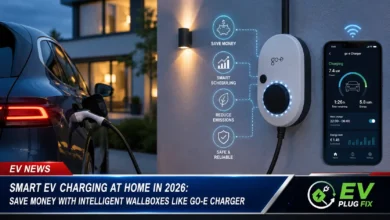
Regulatory compliance is a baseline, but the go-e Charger Gemini series offers much more. From PV-oversupply charging and intuitive smartphone app control to RFID access management and detailed charging statistics, the Gemini is a powerhouse of features. As technology evolves, innovations like dynamic wireless power transfer and vehicle-to-everything (V2X) capabilities are on the horizon, signaling a future where EVs are integral to the smart grid. Staying informed about Vehicle-to-Grid Regulations will help you prepare for the next phase of EV energy integration.
With the correct setup, your go-e Charger Gemini will not only satisfy current regulations but also position you at the forefront of the modern EV charging ecosystem. Ready to get started? Review the detailed PDF guide from go-e for the Gemini series or consult a certified electrician to plan your installation.