Surplus PV Charging: Turn Solar Energy Into Free EV Fuel in 2026
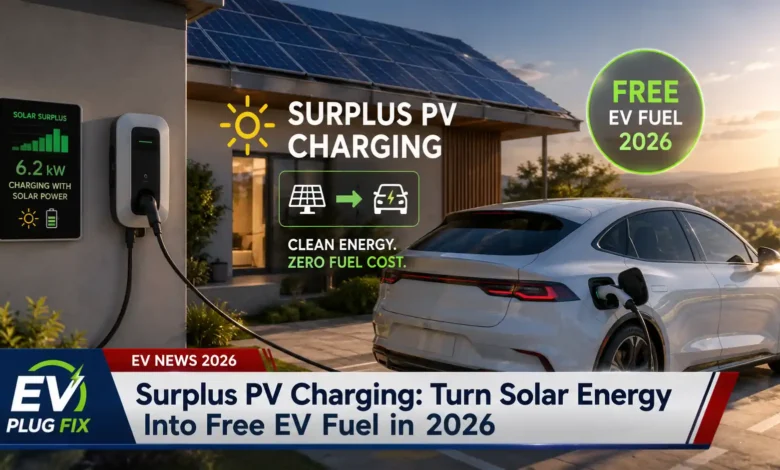
Surplus PV charging lets EV owners with home solar panels turn excess sunshine into free, zero-emission driving, slashing both energy bills and carbon footprints. For anyone with a solar array and an electric car, this technology is the key to unlocking the full financial and environmental potential of your investment. By using surplus solar power to charge your EV, you can stop exporting cheap energy to the grid and start fueling your car for a fraction of the cost. Before diving into the technical details, it’s worth exploring the broader landscape of Home EV Charger Guide to see how surplus charging fits into a modern smart home ecosystem.
Charging infrastructure expansion across Europe is accelerating rapidly, creating new opportunities to make home EV charging truly clean and cost-effective.
⚡ Key Takeaways: Solar PV Surplus EV Charging
- Free Zero-Emission Fuel: Diverts excess home solar generation directly into your EV battery instead of exporting it to the grid for low feed-in tariffs.
- Massive Cost Savings: Saves over €1,700 annually compared to retail electricity prices by boosting home energy self-consumption.
- Automated Dynamic Charging: Smart wallboxes dynamically adjust charging current in real-time based on live solar output.
- Open Standard Compatibility: OCPP (Open Charge Point Protocol) connects solar inverters, smart meters, and chargers across different brands seamlessly.
What is Surplus PV Charging and How Does It Work?
Surplus PV charging is a smart energy management system that directs the excess electricity your solar panels generate to your electric vehicle. When your panels are producing more power than your home needs, this ‘surplus’ is typically exported to the grid for a low feed-in tariff. Surplus charging diverts that power to your EV’s battery instead.
Dynamic PV surplus charging uses an intelligent charging station that instantly detects when surplus energy is available and automatically starts and regulates the charging process. This is done by continuously checking the energy available and adapting the charging power accordingly, making the whole process fully automatic after initial setup.
⚡ Expert Tip: For dynamic surplus charging to work seamlessly, you need a compatible smart charger coupled with a bi-directional meter to measure grid import/export. This allows the system to know exactly when surplus is available. Understanding AC to DC Conversion is also helpful, as it explains how solar energy gets transformed into usable power for your EV battery.
Top 5 Groups Who Benefit from Surplus Solar EV Charging
While the technology is fascinating, the real story is about who stands to gain the most. Surplus PV charging offers a range of benefits for different types of EV owners.
1. Private EV Owners with Home PV Systems
If your car is parked at home during daylight hours—even for just a few hours—you’re in the ideal position. Every sunny hour is an opportunity to turn unused solar power directly into driving range. It transforms your driveway into a private, zero-cost fuel station.
- Why private owners benefit: It maximizes the utility of the hardware you already own. You’re not just generating electricity; you’re generating the most expensive commodity it can power: your car’s fuel.
2. Homeowners Wanting a Faster Solar ROI
Selling surplus energy to the grid for a few cents and buying it back later for much more makes little financial sense. The price gap is significant. In many European regions, the feed-in tariff is under 9 cents per kWh, while residential retail prices can reach 38 cents per kWh. Using that energy to charge your car instead can improve your solar panel’s return on investment (ROI) significantly.
- Financial logic: By replacing grid electricity with your own solar power, you’re saving money at the full retail rate. A 6 kWp solar system charging an EV can shift roughly 5,800 kWh per year from grid import to direct PV self-consumption, saving over €1,700 annually.
3. Environmentally Conscious Drivers
Charging with your own solar power reduces CO₂ far beyond just driving an electric car. It ensures that the energy powering your vehicle is genuinely green at the socket, eliminating the hidden emissions of charging from a fossil-fuel-heavy grid.
- The eco-edge: Reports from energy institutes highlight that compared to traditional grid-powered charging stations, a PV-powered charging station’s carbon impact can be between 1.5 and 10 times smaller, depending on the local grid energy mix.
4. Tech-Savvy Users and Smart Home Enthusiasts
For those who love data and optimization, surplus PV charging is a playground. It offers granular control and data visualization through smart charger apps, which allow you to select modes like ‘Surplus only’ or ‘Limited grid usage’ to fine-tune your charging behavior. To fully leverage this, integrating your system with Networked EV Chargers can provide even deeper connectivity and automation options within your smart home ecosystem.
- Why tech-savvy users benefit: Integrating your car into your smart home ecosystem provides a satisfying level of control and automation. You can schedule charging, monitor energy flows, and even integrate with open-source platforms like Home Assistant for custom automations.
5. Drivers with Fleets or Multi-Car Households
The financial and environmental logic of surplus charging scales effectively. By integrating an Open Charge Point Protocol (OCPP) compliant charger into a home energy management system, one can force multiple chargers to divide available solar surplus among active charging sessions.
- Why fleets and multi-car households benefit: With OCPP, systems can support smart charging profiles and handle the load balancing needed for multiple vehicles. This makes it viable for households with multiple EVs and small business fleets to maximize their solar yield across their vehicles.
Making Surplus PV Charging Work: Key Technologies and Considerations
OCPP: The Protocol That Makes It All Work
The technical magic behind a flexible and future-proof solar charging setup often comes down to one protocol: OCPP. The Open Charge Point Protocol (OCPP) is the universal language that lets your EV charger talk to a central management system, such as your solar inverter or a home energy management system. This open standard overcomes vendor lock-in, meaning you can choose hardware from different manufacturers without being forced into a single ecosystem. For property owners looking to install EV chargers, understanding Best Rental Property EV Charger options can also help in making versatile installations that benefit both tenants and landlords.
| Feature | OCPP 1.6-J (Most Common Today) | OCPP 2.0.1 (Future-Proof) |
|---|---|---|
| Smart Charging | SetChargingProfile (Basic) | Central, Local, & External variants |
| ISO 15118 Support | No native support | Native ‘Plug and Charge’ support |
| V2G Integration | Workarounds only | Native support via extensions |
| Ideal Use Case | Residential solar setups | Large fleets & V2G applications |
Smart Modes: ‘Surplus Only’ vs. ‘Limited Grid’
Leading charger manufacturers offer intuitive modes to manage solar charging. Their ‘Surplus only’ mode means your car will only charge when solar surplus exceeds a minimum threshold (typically 6A or 1.4 kW). Meanwhile, ‘Limited grid usage’ allows the car to charge using a minimum amount of grid power to guarantee a baseline charge, supplementing with solar surplus whenever available.
Future Outlook for Surplus PV Charging
As the need to cut emissions grows, Hybrid Renewable Energy Systems are gaining widespread attention. This is where surplus PV charging truly shines. Looking toward the future, solar EV charging is not a niche hobby but a central pillar of a sustainable, cost-effective home energy system. The ability to store and manage energy through EV Backup Power and Bidirectional EV Charging technologies will further enhance the value of surplus solar charging, turning your EV into a mobile energy bank for your home.
New technologies, such as integrated ‘All-in-One’ power systems that combine solar PV, battery storage, and fast EV charging, show that the industry is moving towards a unified and highly efficient future. With innovations in Multi-Stage Constant Current charging that improve battery health, home EV charging is becoming faster, smarter, and more sustainable.
Key Takeaway: Surplus PV charging is a powerful way for EV owners to reduce costs, maximize their solar investment, and drive with a clearer conscience. It’s not just a technology; it’s a smarter way to live in the 21st century.
Ready to explore how surplus PV charging can work for your home? Our team at EVPlugFix can provide the latest insights on compatible chargers, installation, and energy management systems. Contact us to learn how you can start driving on sunshine today.