EV Regenerative Braking Efficiency: 7 Critical Factors That Impact Range in 2026
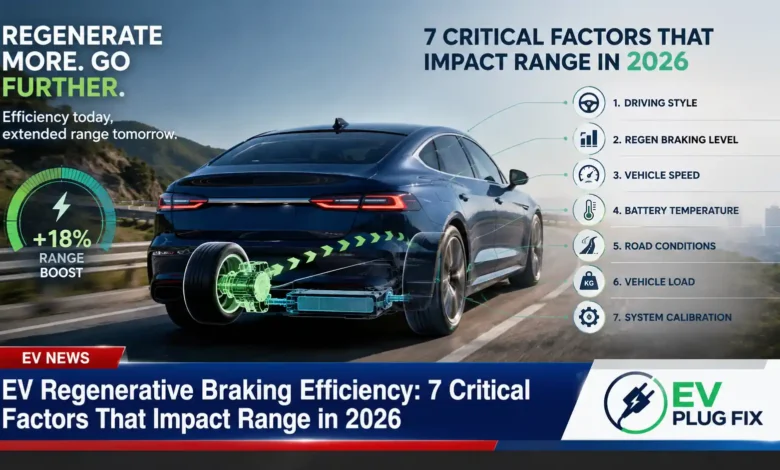
Regenerative braking efficiency depends on multiple interconnected factors that determine how effectively your electric vehicle captures kinetic energy during deceleration. While many EV owners assume maximum regeneration equals maximum efficiency, the reality is far more nuanced. We’ve investigated the seven critical elements that influence recuperation performance in 2026, backed by real-world testing and engineering data.
Whether you’re a seasoned EV driver or new to electric mobility, understanding these factors can help you optimize your driving habits and potentially extend your vehicle’s range by up to 15% in urban environments. Let’s dive into what actually matters when it comes to regenerative braking.
1. Urban vs. Highway Driving Environment
The driving environment plays perhaps the most significant role in regenerative braking efficiency. City driving with its frequent stops, traffic lights, and intersections creates ideal conditions for energy recovery. One-pedal driving systems truly shine in these environments, allowing drivers to decelerate smoothly while maximizing battery recharging.
Highway driving tells a completely different story. When you maintain constant speeds for extended periods, braking opportunities become scarce. The minimal deceleration that occurs on highways generates little regenerative energy, making this environment less effective for recuperation despite the higher speeds involved.
“City driving can recover 4-5 times more energy through regenerative braking compared to highway driving, making urban routes actually more efficient for EVs in terms of energy recuperation.”
2. Road Gradient and Terrain Profile
Road gradients significantly influence regenerative braking performance, with downhill sections providing exceptional recuperation opportunities. As vehicles descend, the regenerative braking system works harder at higher speeds, capturing substantial kinetic energy that would otherwise be lost as heat in conventional braking systems.
The ideal scenario combines steep, lengthy descents where the system can operate at peak efficiency. Mountain driving often yields impressive regenerative performance, with some EV owners reporting battery charge increases of 5-10% during extended downhill sections. However, the uphill sections that precede these descents require more energy consumption, so the net benefit depends on the complete route profile.
3. Vehicle Speed Dynamics
Speed directly correlates with kinetic energy, creating an interesting efficiency paradox. Higher speeds mean more kinetic energy available for recovery, yet highway driving offers fewer braking opportunities. The most effective regenerative braking occurs during moderate-speed decelerations, typically between 30-60 mph, where the system can capture substantial energy without the parasitic losses that occur at extreme speeds.
Optimal speed management involves maintaining steady acceleration and anticipating deceleration points. This technique allows for smoother, more extended braking events that maximize energy capture while minimizing wear on friction brakes.
4. Vehicle Weight and Mass
Heavier electric vehicles possess more kinetic energy, enabling greater energy recovery during deceleration. For instance, a Tesla Model X regenerates more energy during braking than a Model 3 at the same speed, simply due to its additional mass. However, this advantage comes with a significant trade-off.
The additional weight requires more energy during acceleration, offsetting much of the regenerative benefit. The overall efficiency gain from weight-related recuperation typically remains modest, demonstrating why lightweight vehicle design remains crucial for overall EV efficiency despite regenerative braking’s capabilities.
5. Motor and Drivetrain Configuration
Not all electric powertrains regenerate equally. Dual-motor configurations generally recover more energy during deceleration than single-motor systems because both motors participate in energy conversion. This dual-motor advantage becomes particularly noticeable during aggressive deceleration, where the system can capture more kinetic energy before it dissipates as heat.
However, the efficiency difference varies significantly between manufacturers and specific vehicle models. Some single-motor systems achieve impressive recuperation rates through advanced motor control algorithms that optimize energy capture, proving that engineering sophistication can offset hardware limitations.
6. Driver Behavior and Anticipation
Driver behavior represents the most controllable factor affecting regenerative braking efficiency. Smooth, anticipatory driving that looks ahead and plans deceleration events yields maximum energy recovery. This approach allows for longer, more gradual braking events that optimize the regenerative system’s capture capabilities.
Aggressive driving patterns with hard acceleration followed by emergency braking dramatically reduce regenerative efficiency. When you treat every green light as a race start only to slam on brakes at the next red light, you’re essentially wasting the kinetic energy that regenerative systems work to capture.
7. Regeneration Level and Settings
Modern EVs offer various regenerative braking levels, typically ranging from low to maximum or “one-pedal” mode. Many new EV owners mistakenly assume that maximum regeneration always delivers optimal efficiency. However, the most efficient setting depends entirely on your driving conditions and habits.
Lower regeneration levels often prove more efficient on highways where the vehicle can coast naturally, while maximum settings excel in stop-and-go traffic. Some premium EVs now incorporate AI-driven systems that automatically adjust regeneration levels based on navigation data, traffic patterns, and driver behavior, optimizing efficiency without driver intervention.
Comparing Regenerative Efficiency Across Driving Scenarios
| Driving Scenario | Regenerative Efficiency | Range Impact | Optimal Setting |
|---|---|---|---|
| City Traffic | High (60-70%) | +10-15% range | Maximum regen |
| Highway Driving | Low (15-20%) | Minimal impact | Low regen |
| Mountain Descents | Very High (70%+) | +5-10% charge | Maximum regen |
| Mixed Routes | Moderate (35-45%) | +5-8% range | Medium/Adaptive |
Advanced Regenerative Braking Tips for 2026
Understanding these factors is just the beginning. Here are practical strategies to optimize your EV’s regenerative braking performance in 2026:
- Use predictive navigation – Many EV navigation systems now include terrain data that can optimize battery use and regeneration settings
- Master one-pedal driving – Practice smooth accelerator control for maximum recuperation in city environments
- Adjust settings dynamically – Change regeneration levels based on your current driving environment rather than leaving them static
- Monitor energy flow – Use your dashboard display to understand real-time recuperation performance and adjust accordingly
- Combine with preconditioning – Battery temperature affects regeneration efficiency, so consider preconditioning for optimal performance
Practical Regeneration Optimization Checklist
- Analyze your daily routes – Identify sections where maximum regeneration can benefit your specific commute
- Experiment with settings – Test different regeneration levels on familiar routes to find what works best for you
- Practice anticipatory driving – Look ahead to plan smooth deceleration events
- Monitor your efficiency metrics – Track your energy recovery data to measure improvement
- Update your vehicle software – Manufacturers frequently improve regenerative algorithms through over-the-air updates
Final Verdict: Maximizing Your EV Range Through Smarter Regenerative Braking
The science of regenerative braking reveals that efficiency isn’t about simply cranking the regeneration to maximum. It’s a complex interplay of driving conditions, vehicle characteristics, and driver behavior, all interacting to determine how much energy you actually recover.
By understanding these seven critical factors, you can make informed decisions about your driving habits and vehicle settings, potentially adding significant range to your daily driving experience. The most successful EV owners don’t just drive — they actively manage their energy recovery using the tools and techniques we’ve outlined above.
Remember that regenerative braking represents just one component of overall EV efficiency. Combining optimized recuperation with proper tire pressure, efficient climate control use, and aerodynamic considerations creates a comprehensive approach to maximizing your electric vehicle’s range and performance.