Plug and Charge EV Technology 2026: How It Works & Which Cars Support It
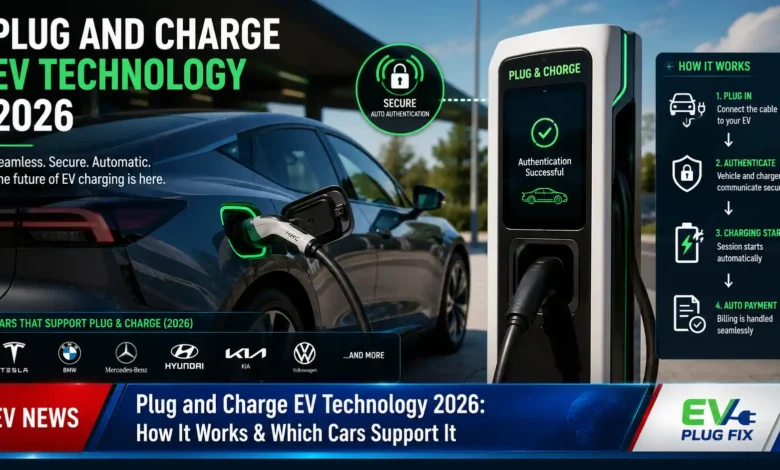
Plug and Charge EV technology is redefining the public charging experience for electric vehicle owners, eliminating the familiar shuffle for RFID cards, smartphone apps, or credit card readers. Based on the ISO 15118 communication standard, this system allows an electric vehicle to securely identify itself to a compatible charging station the moment the cable is connected, automatically starting the session and processing payment entirely in the background . The core of this technology relies on a robust Public Key Infrastructure (PKI) where digital certificates stored in the vehicle are validated by the charger, creating a seamless and secure handshake that makes charging as simple as plugging in and walking away . For drivers who frequently rely on public infrastructure, understanding the Public EV Fast Charging landscape is essential to maximizing the benefits of this automated system.
⚡ Important 2026 Update: Volvo is rolling out Plug & Charge to the EX90 in the U.S., supported at over 35,000 fast-charging stations including Tesla Superchargers and Ionna . Meanwhile, Kia has launched the feature for 2025 EV6 and 2026 EV9 models through its Charge Pass program .
What Is Plug and Charge and How Does It Work?
Plug and Charge, often abbreviated as PnC, transforms the public charging workflow by removing every manual step except connecting the cable. Instead of relying on external payment methods, the vehicle itself becomes the payment actor. The process is enabled by the ISO 15118 standard, which governs the digital communication between the EV and the Electric Vehicle Supply Equipment (EVSE). The seamless nature of this technology stands in stark contrast to traditional refueling costs, and many drivers are curious about the overall financial implications—a topic thoroughly explored in our EV Charging vs Petrol Cost Com analysis.
The technical flow operates as follows:
- Connection and Handshake: When you plug a compatible vehicle into a PnC-enabled station, the vehicle and charger establish a secure communication link using Power Line Communication (PLC) over the CCS connector .
- Secure Authentication: The EV transmits a digital certificate (a contract certificate) to the charging station. This certificate is validated through a PKI managed by a trusted authority, confirming the vehicle’s identity and its associated payment method .
- Automatic Billing: Once the certificate is verified, the charging session begins. Upon completion, the transaction is settled using the driver’s pre-registered payment method without any further action required.
Plug and Charge vs. Autocharge: Understanding the Security Difference
While Plug and Charge is often compared to another “plug-in” solution known as Autocharge, there is a critical distinction in their security architecture. Autocharge identifies a vehicle based on its MAC address. However, this method is considered less secure and more susceptible to fraud because MAC addresses can be spoofed or cloned .
In contrast, Plug and Charge leverages ISO 15118 and PKI-based digital certificates. This framework uses encryption (TLS) and a Certificate Trust List (CTL) to ensure that only authorized vehicles can initiate a session, offering enterprise-grade security that protects against misuse and manipulation . As the industry moves toward smarter, more secure infrastructures, innovations like AI EV Charging Solutions are complementing these security protocols to optimize grid integration and user experience.
🔑 Expert Insight: The future of Plug and Charge is heading toward a universal standard. The SAE EVPKI framework, backed by the Joint Office of Energy and Transportation, is working to ensure that by 2030, any EV will automatically authenticate and charge on any public station using the same secure certificate trust list .
Which Cars Support Plug and Charge in 2026?
Adoption of Plug and Charge is accelerating, with major automakers integrating the technology into their latest EV models. Currently, support is strongest among European and Asian manufacturers, though the technology is set to become ubiquitous across all new EVs in the coming years. The momentum in Europe is particularly noteworthy, as reflected in the latest sales data from our Europe Best-Selling EVs report, which shows a strong correlation between advanced feature sets and market performance.
As of 2026, Plug and Charge is available on a wide range of vehicles, with specific support varying by region and software version. Prominent automakers include the VW Group (ID. series, Audi e-tron, Porsche Taycan), BMW, Mercedes-Benz, and Ford . Recent 2026 model-year additions have expanded this list:
- Volvo: Available on the EX90 (and the upcoming EX60) in the U.S., with model year 2025 units requiring a free Nvidia Orin computer upgrade .
- Kia: Launched for 2025 EV6 and 2026 EV9 models via the Kia Charge Pass .
- Hyundai, Genesis, Cupra, Skoda, and Smart: Continue to support the standard across their dedicated EV platforms.
It is important to note that while the hardware may be capable, some manufacturers have historically limited functionality to specific mobility service contracts or required specific software versions (e.g., VW ID. software 3.1) .
| Automaker | Model/Platform Examples | Notes & Requirements |
|---|---|---|
| Volvo | EX90, EX60 (2026), EX30, EX40, EC40 | U.S. rollout at 35,000+ chargers. 2025 EX90 requires hardware update |
| Kia | 2025 EV6, 2026 EV9 | Requires active Kia Connect subscription and Charge Pass enrollment |
| VW Group | ID.3, ID.4, ID. Buzz, Audi Q4 e-tron, Porsche Taycan | Requires ID.software 3.1 or newer |
| BMW Group | BMW i-Series, Mini Cooper | Ongoing support for newer models |
| Mercedes-Benz | EQ Lineup | Active integration with Mercedes me Charge |
Charging Networks Supporting Plug and Charge
For Plug and Charge to function, both the vehicle and the charging station must support the ISO 15118 protocol. While the network of compatible chargers is expanding, not all public stations are equipped yet. IONITY remains one of the most prominent supporters of Plug and Charge in Europe, offering the service across its network of ultra-fast chargers .
In the U.S., Volvo owners can use the feature at over 35,000 fast-charging stations, including major players like Tesla Superchargers (via the North American Charging Standard) and the Ionna network. The EMVCo has also published a solution to integrate card-based payments into ISO 15118 systems, which is expected to further accelerate adoption by simplifying backend integration for charging point operators . As drivers transition between home and public charging, understanding the fundamentals of EV Wallbox Installation ensures they can complement public PnC convenience with an efficient home setup.
Why Isn’t Plug and Charge Everywhere Yet?
Despite its convenience, Plug and Charge adoption faces several ecosystem-level barriers. One of the main hurdles is that many older EVs on the road were not factory-equipped with the necessary hardware and PKI certificates to support Plug and Charge, meaning they cannot be retrofitted to gain this functionality .
Another challenge lies in interoperability. Historically, automakers and charging networks have used proprietary solutions, creating a fragmented experience. While the new SAE EVPKI and Multi-Root PKI frameworks are designed to solve this by creating a common security standard, the industry is currently in a transition phase where compatibility is not yet guaranteed across every combination of car and charger . For EV owners concerned about infrastructure resilience, exploring solutions like EV Charging Power Outages can provide peace of mind during this transitional period.
The Future: Universal Plug and Charge by 2030
The vision for the future is a fully interoperable ecosystem where any EV can charge at any station simply by plugging in. By 2030, it is estimated that 100% of new EVs will be compatible with Plug and Charge . The key driver of this transformation is the SAE EVPKI framework, a public-private partnership establishing a Certificate Trust List (CTL) that will allow vehicles, chargers, and charging networks to securely communicate with one another, regardless of manufacturer . This universal approach will ultimately simplify the charging experience, making it more predictable for drivers who have researched Used EV Ownership Costs and are looking to optimize their long-term savings.
“Universal Plug & Charge levels up the electric fueling experience—making it even easier than filling up with gas. We are rapidly approaching a future where every EV driver can just plug in, charge up, and go.”
— Gabe Klein, Executive Director, Joint Office of Energy and Transportation
This advancement is also crucial for enabling future technologies like Vehicle-to-Grid (V2G) integration, where bidirectional energy flows will require secure and automated communication between the vehicle and the grid . Additionally, new payment models are emerging. While OEMs currently manage credentials, the market is likely to see competition from card schemes and eMSPs for control over the payment layer, promising even greater flexibility and choice for drivers in the near future .