EV Charger Temperature Sensors Explained: Battery vs Charger Safety 2026
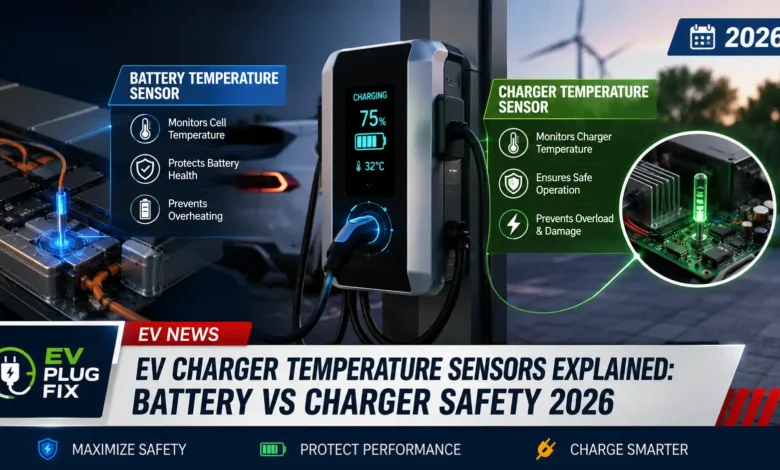
Temperature sensors embedded in EV chargers and batteries represent the first line of defense against thermal events that could compromise vehicle safety, battery longevity, and charging efficiency. With global electric vehicle sales projected to reach 20 million units by 2025, representing over one-quarter of new vehicle sales according to the International Energy Agency , understanding how these critical components work has never been more important for EV owners and industry professionals alike. Modern EV Charger Standby Power management also relies on temperature data to optimize energy consumption when vehicles are not actively charging.
As EV charging technology advances toward higher power outputs exceeding 350 kW, thermal monitoring has evolved from a simple safety feature to a sophisticated network of sensors that balance protection with performance optimization. Implementing Decentralized EV Charging Architecture requires robust temperature monitoring at every node to ensure system-wide reliability. But not all temperature sensors serve the same purpose or face the same challenges.
“Electric vehicle charging is an exceptionally high, long-lasting, and repetitive electrical load compared to regular household electrical loads,” making temperature monitoring essential for safety .
How EV Charger Temperature Sensors Protect Your Battery
Battery temperature sensors are the guardians of your EV’s most expensive component. These sensors are typically installed directly inside battery cells or within the battery pack itself, with common configurations including surface mounting directly onto cells, placement near battery tabs, or integration directly into the Battery Management System (BMS) circuit board. Their proximity to the cells ensures accurate measurement of the battery’s actual temperature, which is critical because lithium-ion batteries generate significant heat during charging through both Joule heating and electrochemical reactions .
Research has demonstrated that lithium-ion batteries achieve optimal performance and extended lifetime when operating temperatures are maintained at approximately 15-35°C . When temperatures exceed this range, the battery’s internal chemistry begins to degrade, leading to diminished capacity and shortened lifespan. For a deeper understanding of battery longevity, explore our analysis on Tesla Battery Lifespan and how thermal management directly impacts degradation rates. More dangerously, temperatures above 50°C can trigger thermal runaway — a chain reaction that has been linked to fires and explosions in electric vehicles.
Multi-Level Temperature Protection Strategies
Modern Battery Management Systems implement sophisticated multi-level protection strategies based on temperature data. These typically include:
- When battery temperature reaches 40°C, reduce charging current to minimize additional heat generation
- At 45°C, switch to trickle charge mode with significantly reduced power
- Above 50°C, stop charging completely to prevent thermal runaway
Advanced systems also employ predictive algorithms that analyze temperature curves to anticipate dangerous temperature rises and adjust charging parameters before thresholds are breached. This proactive approach to thermal management is especially important during fast charging scenarios, where battery temperatures can rise rapidly in a short period . Modern OCPP Charging Protocol implementations enable real-time temperature data sharing between chargers and management platforms for coordinated thermal response.
In many electric vehicles, battery packs contain dozens or even hundreds of temperature sensors distributed at various locations throughout the pack, creating a comprehensive thermal monitoring network that ensures each battery module operates within its safe temperature range. This distributed approach is essential because temperature variations between cells can lead to performance imbalances and reduced pack longevity.
Charger Temperature Sensors: Protecting the Equipment
While battery sensors focus on the vehicle’s energy storage, charger temperature sensors protect the charging equipment itself. These sensors are primarily installed near critical heat-generating components within the charger, including power conversion circuits, power semiconductor devices (MOSFETs and diodes), transformers, and rectifier bridges .
During operation, chargers generate considerable heat due to losses in the power conversion process. In high-power charging applications — such as the 350 kW DC fast chargers becoming increasingly common — the temperature of power devices can rise rapidly, threatening both the reliability and safety of the charger. Built-in temperature sensors constantly monitor the charger to prevent overheating, as seen in products like the Anker SOLIX V1 Smart EV Charger, which operates in temperatures from -30°C to 50°C with integrated thermal protection .
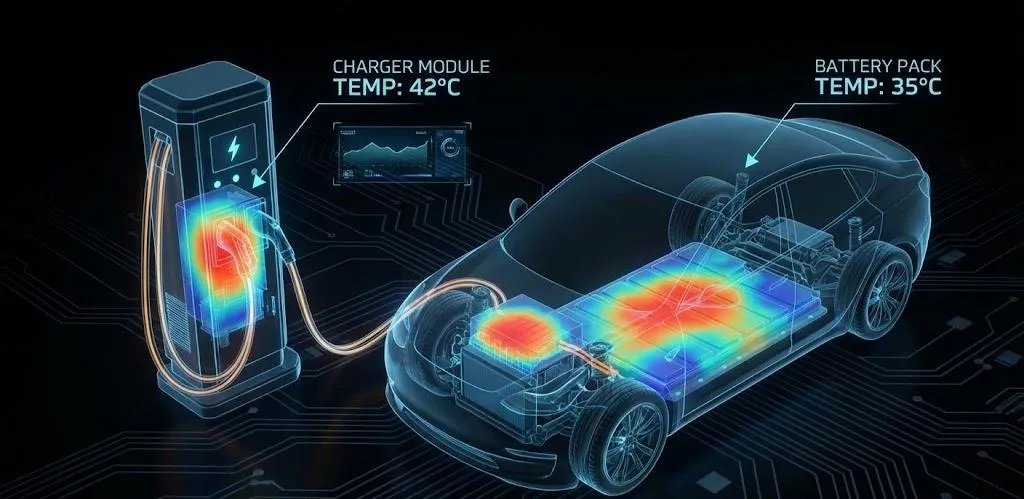
Modern EV battery packs integrate dozens of temperature sensors to create a comprehensive thermal monitoring network.
The thermal thresholds for charger components differ significantly from those of batteries. While batteries typically trigger protection at 45-60°C, charger temperature sensors may have alarm thresholds set at 70-90°C or even higher. This is because electronic components like MOSFETs generally have better temperature resistance than lithium-ion batteries, capable of short-term operation at 180-200°C according to IEC 61851 standards .
Comparative Analysis: Battery vs Charger Temperature Sensors
Understanding the key differences between battery and charger temperature sensors is essential for anyone involved in EV ownership, maintenance, or infrastructure planning. Here’s how they compare across critical dimensions:
| Characteristic | Battery Temperature Sensors | Charger Temperature Sensors |
|---|---|---|
| Monitoring Target | Battery cell temperature during charge/discharge | Power electronics and components within the charger |
| Primary Safety Concern | Preventing thermal runaway, fire, or explosion | Preventing equipment damage and maintaining reliability |
| Typical Alarm Threshold | 45-60°C (lithium-ion battery limits) | 70-90°C (component temperature tolerance) |
| Response Time | Fast (seconds) due to direct cell contact | Moderate (heat conduction from source to sensor) |
| Control Strategy | Derate current, reduce charge speed, stop charging | Reduce output power, activate cooling fans, or stop output |
| Sensor Type Common | NTC thermistors, thermocouples | NTC thermistors, semiconductor sensors, thermal switches |
Collaborative Monitoring Network: How Both Systems Work Together
In modern electric vehicle charging systems, battery and charger temperature sensors do not operate in isolation. They form an integrated monitoring network enabled by intelligent communication protocols such as USB PD, CCS, and proprietary fast charging standards . This collaboration enables sophisticated thermal management that maximizes both safety and efficiency. Advanced systems that leverage EV Charger Cybersecurity Best Practices ensure that temperature data transmitted between devices remains secure from tampering or interception.
When a temperature increase is detected, the system can implement coordinated protection strategies. For example, if the Battery Management System detects rising battery temperatures, it can communicate with the charger to request reduced output current. Simultaneously, if the charger’s internal temperature sensors detect excessive heat, it proactively reduces output power even without receiving a request from the vehicle.
Recent innovations have pushed this collaboration further. Some systems now incorporate dual-monitoring safety technologies that use both RGB imaging and infrared thermal technology to continuously monitor charging connectors and sockets, detecting abnormal temperature conditions before they become critical .
“The infrared thermal camera monitors the temperature of the vehicle battery from below, enabling early detection of overheating or abnormal conditions and reducing the risk of thermal runaway.”
Technological Advancements in Temperature Sensing 2026
The field of EV temperature monitoring continues to evolve rapidly, with several emerging trends shaping the future of charging safety:
Precision Sensing Technologies
Advanced sensors like the DS18S20 digital temperature sensor offer high accuracy and low power consumption, making them ideal for embedded systems that require reliable measurements without recalibration. With factory calibration maintaining ±0.5K accuracy, these sensors are finding applications in battery and charger protection systems .
Specialized Protection ICs
Products like the Wayon WP1681 represent the next generation of temperature protection, using external NTC thermal sensors to control built-in NMOS switches that disconnect power when temperature exceeds allowed thresholds. These ICs operate stably in harsh conditions and protect charging devices from overheating while maintaining energy efficiency .
Integrated Thermal Management Systems
Research into integrated thermal management systems (ITMS) demonstrates the importance of holistic temperature control. Studies have shown that systems employing dual-suction compressors can achieve improvements in cooling capacity by 16.5-43.7% and coefficient of performance by 1.8-29.4% compared to conventional designs .
Bionic Cooling Solutions
Innovative approaches like bionic fern vein cold plates coupled with phase change materials have demonstrated the ability to maintain battery module temperatures as low as 37.1°C under New European Driving Cycle conditions, with maximum temperature differences held to just 2.5°C .
What This Means for EV Owners in 2026
For the average electric vehicle owner, these thermal monitoring technologies translate directly to practical benefits: safer charging experiences with dramatically reduced risk of thermal events, extended battery life through consistent temperature management, and faster charging speeds enabled by smarter thermal control systems. Understanding your charger’s capabilities is essential; for example, the go-e Gemini Flex Review highlights how advanced temperature monitoring integrates with smart charging features for optimal performance.
The integrated thermal monitoring approach also contributes to improved vehicle range by maintaining battery efficiency. Research has shown that a well-designed thermal management system can significantly improve driving range by ensuring batteries operate at optimal temperatures and reducing auxiliary power consumption for cooling .
Best Practices for EV Owners
- Monitor charging temperatures when possible through your vehicle’s mobile app or dashboard interface
- Charge in moderate temperatures when practical, avoiding both extreme heat and freezing conditions
- Be aware of derating – if your charger reduces speed, it’s often a safety function responding to temperature data
- Maintain your charging equipment – ensure ventilation openings and cooling systems remain unobstructed
The Future of EV Thermal Monitoring
As charging speeds continue to increase, the sophistication of temperature monitoring systems will need to keep pace. The industry is moving toward systems that can predict and prevent thermal issues before they occur, using artificial intelligence algorithms to analyze temperature data patterns . With battery voltages approaching 800V and charging power exceeding 350kW, the thermal management systems of the future will require even more precise monitoring and rapid response capabilities . Innovations in PWM EV Charging Technology are enabling more granular control over charging profiles based on real-time temperature feedback.
Fiber-optic temperature sensing represents one promising frontier, offering immunity to electromagnetic interference and inherent electrical isolation that makes it suitable for ultra-fast charging environments where traditional sensors may face limitations . Similarly, advances in dual-evaporator systems that integrate battery cooling with cabin air conditioning demonstrate the industry’s commitment to energy efficiency and occupant comfort alongside battery safety .