EV Charging Speed Factors in 2026: Why Real-World Rates Lag and How to Fix It
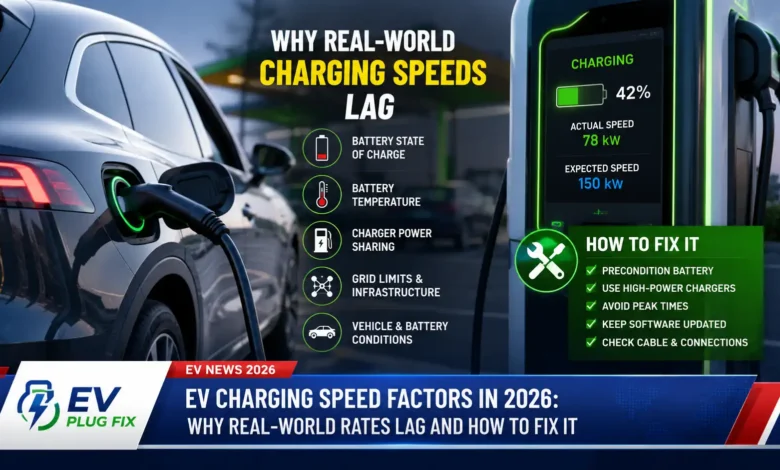
EV charging speed rarely matches the peak number advertised on the charger, leaving many drivers frustrated and questioning their vehicle’s capabilities. In 2026, the reality of charging an electric vehicle involves a complex interplay of battery chemistry, thermal dynamics, and software logic that can slash your rate by over 60% if you are not careful.
This is the central challenge for modern EV ownership, and understanding the EV charging speed factors at play is the first step to taking control. At EVPlugFix.com, we’ve analyzed the latest data and consulted industry experts to cut through the marketing hype and provide a clear, actionable breakdown of why your charging session is taking longer than expected and exactly what you can do about it. For a foundational overview of your options, check out our EV Charging Levels Guide to see how different power levels impact your daily routine.
The Frustrating Reality: Why Your EV Isn’t Hitting Charging Speed Targets
You pull up to a fast charger, plug in, and anticipate a quick 20-minute top-up. Instead, the dashboard shows a rate far lower than expected, stretching your stop to 40 minutes or more. This scenario is incredibly common, and it boils down to your EV’s battery management system (BMS) prioritizing long-term health and safety over raw speed.
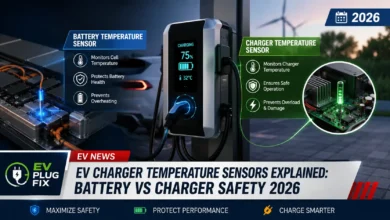
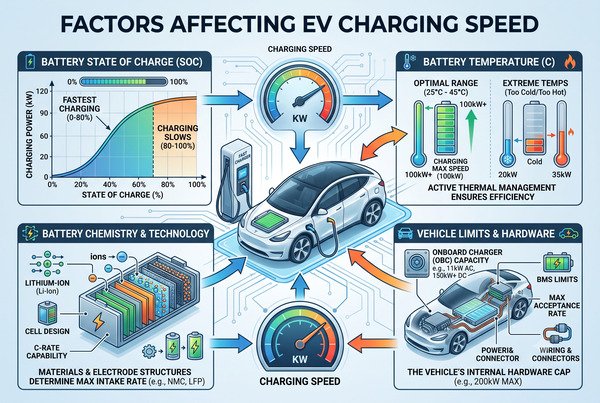
The primary bottleneck often isn’t the charger itself. Battery temperature is a dominant factor. Lithium-ion cells are finicky; they perform best in a specific temperature window, typically between 20°C and 30°C. In cold weather, the BMS severely limits the charging current to prevent lithium plating, which can permanently damage the battery. This can lead to a 30-60% reduction in speed until the pack warms up. Conversely, extreme heat also triggers throttling to prevent overheating.
Another major variable is the State of Charge (SOC). Charging isn’t a linear process. EVs use a charging curve that allows for peak power only in the middle of the battery’s range (roughly 10-50%). As the battery fills up, the BMS tapers the power to protect the cells, with a dramatic slowdown occurring above 80% SOC. Expecting a 150 kW rate at 85% SOC is a recipe for disappointment. Understanding this curve is essential, and you can further explore how charging speeds compare across different power levels in our EV Fast Charger Types analysis.
| Condition | Typical Speed Drop | Common Scenario |
|---|---|---|
| Cold Battery (Below 10°C) | 30-60% | Winter mornings or overnight parking |
| High State of Charge (Above 80%) | 40-70% | Topping off for a long trip |
| Hot Battery (Above 40°C) | 20-40% | Summer afternoons after highway driving |
| Vehicle Acceptance Limit | Hard Cap | Older models or smaller battery packs |
These factors can compound. A cold battery at a high SOC will result in a glacial charging session. Recognizing these variables is the first step to adjusting your expectations and planning more effective stops.
Debunking Common Charging Speed Misconceptions
The marketing materials for public chargers often boast massive kW figures, but this only tells half the story. Several pervasive myths lead drivers to set unrealistic goals, and correcting them is key to a satisfying EV ownership experience.
Myth 1: “A Higher kW Charger Always Means Faster Charging”
This is the most common misunderstanding. The charger provides the potential power, but your vehicle’s onboard charger and BMS determine the actual draw. A 350 kW charger is wasted on a car that can only accept 100 kW. You’re better off finding a charger that matches your vehicle’s peak curve.
Myth 2: “The Charging Speed Should Stay Constant”
It will not. The charging curve is designed to taper. This is a deliberate, protective measure. Expecting a steady 200 kW from 10-90% is like expecting a sprinter to maintain top speed for a marathon. The slowdown at the top end is normal and healthy for your battery.
Myth 3: “Temperature Doesn’t Really Matter”
Temperature is everything. Many drivers are surprised by slow winter charging, thinking the charger is broken. In reality, the BMS is protecting the pack. The 30-60% performance hit in sub-optimal temperatures is a real and significant factor you must account for.
Modern EVs in 2026 are more advanced, with better thermal management and faster-charging chemistries, but the fundamental physics remain. The table below contrasts common fallacies with the reality.
| Misconception | Reality | Impact |
|---|---|---|
| Charger kW is the only metric that matters | Vehicle acceptance rate is the limiting factor | Wasted time and potentially higher charging costs |
| Peak speed is maintained throughout the session | Tapering is a normal part of the charging curve | Disappointment and mis-timed travel stops |
| Ambient temperature has a minimal effect | Temperature has a major impact on ion mobility | Significant slowdowns in winter |
| All EVs have similar charging capabilities | Battery chemistry and architecture vary widely | Incorrect assumptions based on other models |
“Education is the most powerful tool. At Parwatt, we’ve seen fleet operators dramatically improve their efficiency simply by understanding their vehicles’ specific charging curves and preconditioning their batteries before long trips.” – Jacky Huang, GM of Parwatt
The Key Factors That Dictate Your EV Charging Rate
For a comprehensive understanding, it’s useful to break down all the major elements that influence your charging session. These factors interact dynamically, and a holistic view helps in predicting and optimizing your results.
1. Battery Temperature Management
The chemical reactions within a battery are highly temperature-dependent. A cold battery offers high internal resistance, slowing the charge. Conversely, if a battery is too hot, the BMS will reduce power to prevent thermal runaway. Using your EV’s preconditioning feature to heat or cool the battery before arrival is the most effective intervention you can make. Modern systems are increasingly sophisticated, and understanding the High-Power EV Thermal Management can give you deeper insight into how your car protects its battery during intense sessions.
2. The Charging Curve and State of Charge
Think of it like pouring a glass of water: you can pour fast when it’s empty, but you must slow down to avoid spillage as it fills up. The same principle applies to electrons entering a battery. The fastest charging occurs between 10% and 50%. Planning your charging stops to utilize this sweet spot can dramatically cut your total travel time.
3. Vehicle-Specific Hardware & Software
Every EV has a different maximum acceptance rate, which acts as a hard ceiling on charging speed. This is determined by the vehicle’s architecture (400V vs. 800V systems) and battery chemistry. Additionally, manufacturers can and do adjust charging performance via over-the-air (OTA) software updates, making it crucial to keep your vehicle’s firmware current.
| Charging Factor | Influence Level | Optimization Strategy |
|---|---|---|
| Battery Temperature | Very High | Always use the scheduled preconditioning feature before a fast-charging session. |
| State of Charge (SOC) | Very High | Target charging from 10% to 60% for the fastest session and continue to 80% if needed. |
| Battery Chemistry & Voltage | Medium-High | Know your vehicle’s peak acceptance rate and don’t pay a premium for faster chargers you can’t use. |
| Thermal Management System | Medium | Park in shaded or moderate-temperature areas to help maintain an optimal pack temperature. |
| Charger Compatibility & Power | Medium | Match your charging session to a station that aligns with your vehicle’s power curve. |
Proven Strategies to Optimize Your Charging Speed in 2026
Knowing the theory is one thing; applying it is where you see real results. By integrating a few simple practices into your routine, you can consistently achieve faster, more predictable charging speeds and minimize time spent at the plug.
Preconditioning is Non-Negotiable: In extreme weather, this single step can improve your charging speed by 20-40%. Most modern EVs allow you to set a departure time in the app, which will automatically manage the battery temperature for optimal performance at your scheduled stop. If you are navigating to a charger, input it as your destination so the car’s BMS can start preconditioning proactively.
Master the Charging Sweet Spot: To maximize efficiency, avoid the temptation to “fill up” at every stop. Frequent fast-charging from 10% to 60-70% is far quicker and can be more efficient for long-distance travel than a single session to 100%. Plan your routes around chargers located at intervals that allow you to arrive in that low SOC window.
Leverage Smart Features: Use your vehicle’s navigation system, which often shows real-time charger status and availability. Some advanced systems can even precondition the battery automatically for an upcoming charge stop. This integration of software and hardware is key to optimizing the entire travel experience. For those interested in how these smart systems integrate with home energy management, our guide on go-e Load Management provides excellent insight into dynamic power distribution.
For a more visual breakdown of how these tips improve your daily charging routine, take a look at this guide on how to optimize your session.
Monitoring your EV charging session via a smartphone app helps you track real-time speed and conditions.
Quick Wins Checklist
- Before You Plug In: Use the app to set a departure time for battery preconditioning.
- At the Station: If possible, choose a parking spot that is out of direct sunlight or sheltered from the wind.
- During Charging: Monitor the session for a few minutes to ensure the speed matches your expectations for the given SOC and temperature.
- System Maintenance: Keep your vehicle’s software updated and regularly check the charging port for any debris or corrosion that could hinder a proper connection.
Your Action Plan for Faster, Smarter Charging
You are now equipped with the knowledge to transform your EV charging experience. The next step is action. Start by reviewing your vehicle’s settings and understanding its specific charging curve—this information is often available in the owner’s manual or via in-car displays.
Implement a new habit: before your next long journey, set the navigation to your first charging stop and enable preconditioning. Monitor the session and note the speeds you achieve. Over time, you will develop an intuitive sense of how your vehicle responds to different conditions, allowing you to plan stops more effectively. If you are also managing charging for a household with multiple EVs, exploring Multi-EV Home Charging strategies can help you optimize your entire home setup.
| Action | When | Expected Result |
|---|---|---|
| Review your EV’s charging settings and app features. | Today | Discover if preconditioning and smart scheduling are enabled. |
| Practice preconditioning before a fast-charging session. | Your next charge | A faster charging session, especially in cold weather. |
| Monitor and log charging speeds under different conditions. | Ongoing | Develop a personal profile of your vehicle’s performance. |
| Evaluate your home charger’s compatibility with your EV. | This Week | Ensure you are not throttling your home charging unnecessarily. |
Conclusion: Charging Smarter, Not Harder in 2026
The future of EV charging in 2026 is not about waiting for a magic battery that charges in five minutes; it is about intelligence. It is about understanding the sophisticated interplay between your battery’s chemistry, its temperature, and its state of charge. The speed you see on the charger is a suggestion, but the speed you actually get is a result of your vehicle’s careful calculations for safety and longevity.
By learning these principles and applying the practical strategies outlined here, you can mitigate the frustration of slow charging. You can turn charging from a passive wait into an active part of your travel strategy, saving you time, money, and stress. The most powerful tool in your EV arsenal isn’t a faster charger, but the knowledge to use the right charger in the right way. To stay ahead of evolving regulations that might affect your charging setup, particularly in Europe, it’s wise to review the European EV Charging Standards to ensure your equipment is fully compliant.