Vehicle-to-Grid Regulation 2026: Key Legal Hurdles & Solutions for EV Drivers
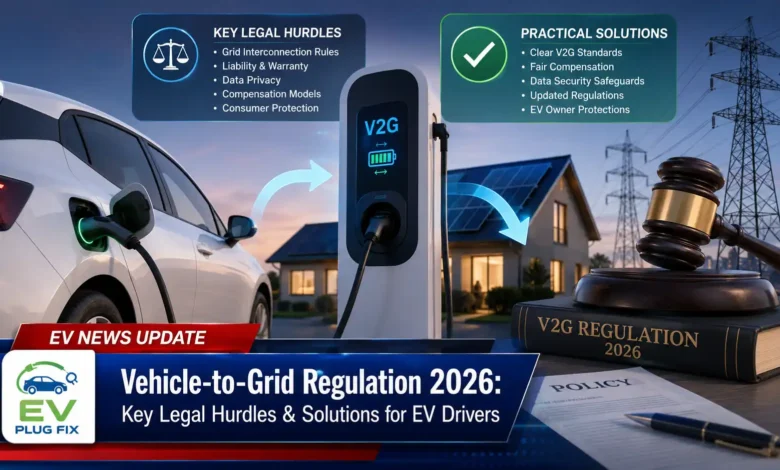
Regulatory challenges surrounding Vehicle-to-Grid (V2G) technology in Germany and Austria are finally being dismantled in 2026, transforming electric vehicles from mere consumers into active, revenue-generating participants in the energy market. After years of being stuck in “pilot purgatory” due to complex legal frameworks and economic disincentives, a series of pivotal regulatory changes are making bidirectional charging a commercial reality.
For EV owners and industry stakeholders, understanding the evolving legal landscape is crucial. The most significant breakthrough came in late 2025 when the German Parliament amended the Energy Industry Act (EnWG), effectively removing the “double grid fee” that penalized V2G participation . Previously, users were charged fees for taking energy from the grid and were then taxed again when feeding it back. The reform now treats EVs as mobile storage units rather than end consumers, making V2G economically viable for the first time. This shift turns a financial penalty into a revenue opportunity, with implications for the entire energy ecosystem. To maximize your savings further, explore EV Time-of-Use Plans that complement bidirectional charging strategies.
Key Regulatory Hurdles and Their 2026 Solutions
While the overarching regulatory environment has improved, several key issues continue to shape the V2G conversation. The following breakdown details the core challenges and their current status, providing a clear roadmap for what EV owners and industry players can expect in 2026. Understanding EV Charging Speed Factors is also essential when evaluating how bidirectional energy flow impacts your daily routine.
| Core Regulatory Issue | Current Status (2026) | Impact on EV Owners |
|---|---|---|
| Data Privacy & Security (Cybersecurity) | Close to a Solution ISO 15118 provides encryption standards, and companies must adhere to GDPR guidelines to avoid fines and maintain trust. The cybersecurity framework is being strengthened to prevent attacks on the vehicle fleet . A recent study proposed a blockchain-based lightweight authentication system to enhance security . |
Your charging data is protected. Regulations require transparency on who has access to your data and why, giving you control over sharing. |
| Network Charges (Double Grid Fees) | Solved Germany’s EnWG reform has eliminated the double charging of grid fees for stored electricity fed back into the grid . |
You are no longer penalized for sending energy back. This makes V2G economically attractive and allows you to earn credits or revenue from your EV battery. |
| Technical Standards & Metering | Solved to a Certain Extent EnWG 14a provides measurement guidelines, and MID-compliant meters in wallboxes can track both incoming and outgoing electricity, making them suitable for bidirectional setups . |
Your wallbox can accurately measure energy flow for fair compensation. New mandates for ISO 15118 standards ensure interoperability between vehicles and chargers . |
| Multi-Tenant & Liability Issues | Not Clear Yet There is currently no comprehensive legal and tax guidance on how financial returns or liabilities are shared in multi-family units or offices where multiple cars share a charger . |
Ambiguity remains about who benefits from energy credits and who is responsible for equipment malfunctions in shared buildings. |
| “Green” Electricity Status | Partially Solved Provisions exist under the Renewable Energy Sources Act (EEG), but the process to confirm green status requires extra bureaucracy. |
Clearer guidelines are needed to streamline the process to ensure solar energy stored in your battery retains its “green” certification. |
V2G Standardization: The Digital Handshake
Beyond the legal and economic frameworks, the technical standardization of V2G communication is rapidly evolving. The introduction of the ISO 15118 standard, often described as the “digital handshake” between a vehicle and a charging station, is a game-changer . From January 2026, all newly installed public charging stations in the EU must support ISO 15118-2, which is the foundation of Plug and Charge Technology. By 2027, the standard will expand to include ISO 15118-20, enabling full bidirectional communication and cross-manufacturer interoperability .
In Germany, the §14a EnWG Compliance Guide also plays a significant role. It provides the legal framework for connecting controllable consumer devices, like EV charging stations, to the grid for targeted energy management . This regulation mandates that new charging stations (from January 2024) be integrated into the grid, allowing network operators to temporarily reduce consumption to prevent overload, a key part of maintaining a stable, decentralized grid. While not a direct V2G mandate, it paves the way for smart energy management that is essential for bidirectional systems. For fleet operators, understanding Choose the Right EV Charger is critical when deploying V2G-compatible infrastructure.
Expert Analysis: The Path to Mass Adoption
For V2G to move from pilots to mass adoption, the industry needs integrated solutions. This includes:
- Robust Technical Standards: Unified protocols that guarantee interoperability while minimizing battery degradation. Learn more about EV Battery Lifespan to understand how V2G affects long-term performance.
- Secure Digital Architectures: End-to-end encrypted communication and security-by-default frameworks .
- Intelligent Coordination: AI-powered energy management systems for real-time optimization between grid stability, renewable energy, and battery preservation .
- Fair Business Models: Transparent compensation for users that accounts for both grid services and battery wear .
Looking Ahead: The V2G Landscape
The focus in 2026 has shifted from whether V2G will happen to how it will happen. With Germany having removed the economic penalty of double grid fees and the EU mandating smart-charging readiness, the table is set for a V2G revolution . However, challenges remain, particularly in creating clear guidelines for multi-tenant buildings and streamlining the bureaucratic process for “green” electricity certification. For EV owners, this presents an unprecedented opportunity to turn their vehicle into a valuable asset for the grid and their wallets. To fully leverage this potential, stay informed about Germany EV Electricity Prices and how they interact with bidirectional energy markets.
The decisive breakthrough came in late 2025 with the reform of the Energy Industry Act. Bidirectional-capable EVs no longer have to pay grid fees on the electricity they feed back, removing the previous double charge.
— pv Europe, reporting on the 2026 regulatory landscape