Networked vs Non-Networked EV Chargers 2026: Which One Is Right for You?
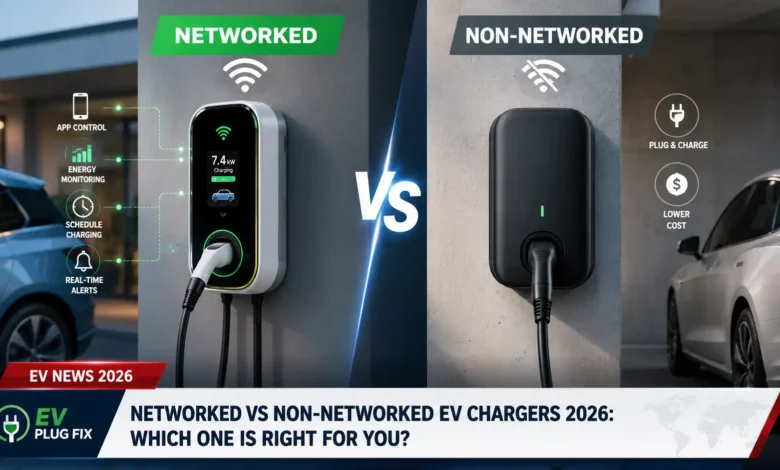
The choice between networked and non-networked EV chargers is quickly becoming one of the most critical decisions for homeowners and businesses in 2026. As the electric vehicle market surges past new adoption records, understanding the distinction between these two types of charging stations is no longer just a technical detail—it’s a strategic necessity. While a common industry shorthand suggests that non-networked chargers are purely for home use and networked units are for commercial settings, this oversimplification hides a complex landscape that can significantly impact costs, convenience, and future readiness.
At EVPlugFix.com, we’ve investigated this topic to cut through the jargon and provide a clear, actionable guide for your specific needs. Whether you are a homeowner looking to charge your first EV or a business owner planning a commercial deployment, this article will help you navigate the critical features and potential pitfalls of both networked and non-networked EV charging solutions. For a deeper dive into residential options, check out our comprehensive Home EV Charger Guide for 2026 installation tips and garage setup advice.
What Defines a Networked EV Charging Station?
A networked EV charger is essentially a smart, connected device. It maintains a persistent or periodic link to a central management platform known as a Charge Point Management System (CPMS). This connection, typically established through Wi-Fi, Ethernet, or 4G/5G cellular networks, enables a sophisticated level of control and monitoring that goes far beyond basic energy delivery. Communication is standardized through protocols like OCPP 1.6 or 2.0.1, ensuring interoperability across different hardware and software providers. For property owners considering multiple units, our guide on Best Rental Property EV Charger installations offers valuable insights into networked solutions for multi-tenant buildings.
This connectivity unlocks a powerful suite of features essential for commercial viability and smart home integration. Networked chargers can:
- Offer real-time remote monitoring of charging status, power output, and energy consumption.
- Enable secure user authentication via RFID cards, mobile apps, or integrated payment systems.
- Facilitate dynamic pricing and automated billing, crucial for public and commercial operators.
- Receive over-the-air (OTA) firmware updates to patch security flaws or add new features.
- Perform intelligent load balancing to manage energy consumption and avoid grid overloads.
- Send fault detection alerts with remote diagnostics, reducing downtime.
- Provide detailed data analytics dashboards for operators to track usage and performance.
These capabilities make networked stations the undisputed backbone of public charging networks like ChargePoint, Blink, and EVgo. They are also indispensable for commercial fleet depots and corporate workplace charging programs, where accountability, access control, and revenue generation are top priorities.
What Defines a Non-Networked EV Charging Station?
In contrast, a non-networked EV charger operates as a fully standalone, “dumb” device. It features no connection to an external server or management platform. When a user plugs in, the charger immediately delivers power—there is no authentication required, no communication to the cloud, and no remote oversight. This approach offers a straightforward solution focused purely on delivering electricity to the vehicle’s battery.
This simplicity is a significant advantage in certain use cases, offering:
- Lower upfront costs with no network hardware or software licensing.
- Simpler installation, often requiring a basic electrical connection without network configuration.
- No ongoing subscription fees, making it a more affordable long-term solution.
- Full operational reliability without dependency on an internet connection.
- Easier maintenance due to fewer components and no software dependencies.
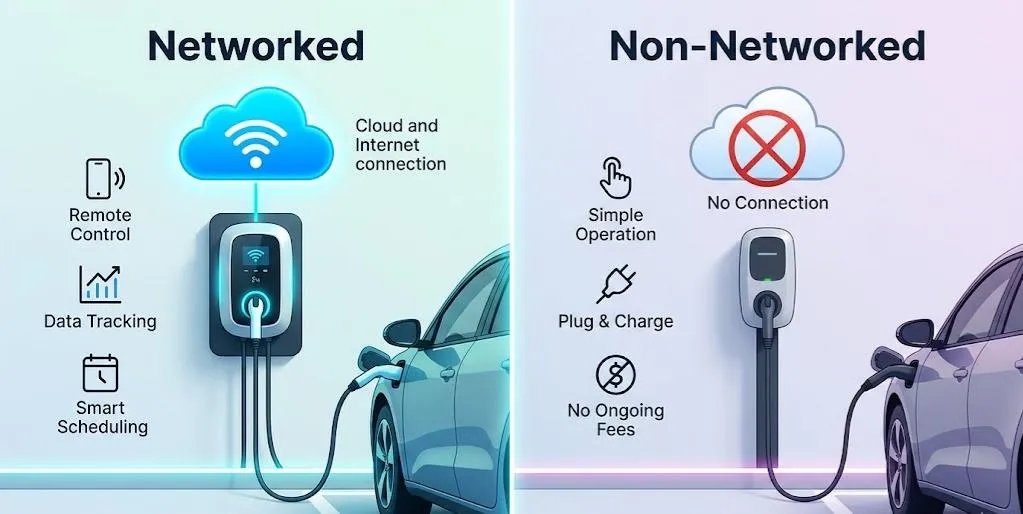
Side-by-side: Understanding where networked and non-networked EV chargers make the most sense.
Networked vs Non-Networked: A Head-to-Head Feature Comparison
To visualize the practical differences, here is a side-by-side comparison of the features offered by each type of EV charging station:
| Feature | Networked EV Charger | Non-Networked EV Charger |
|---|---|---|
| Remote Monitoring | Yes — Real-time data and alerts | No |
| User Authentication | RFID, App, Credit Card | Plug-and-Charge only |
| Dynamic Pricing / Billing | Supported | Not Supported |
| Over-the-Air (OTA) Updates | Yes | Manual / Not Available |
| Energy Management / Load Balancing | Yes | No |
| Fault Alerts & Diagnostics | Remote alerts and diagnostics | On-site inspection only |
| Data Reporting | Full cloud reporting and analytics | None |
| Upfront Hardware Cost | Higher ($500 – $2,500+) | Lower ($200 – $600) |
| Ongoing Subscription Fee | Typically Required ($100 – $500+/year) | None |
| Installation Complexity | Moderate to High | Simple |
| Typical Deployment | Commercial / Fleet / Public / Smart Homes | Residential / Private |
| Internet Connectivity Required | Yes | No |
The Big Question: Does Non-Networked Equal Home Use in 2026?
This is the central question we set out to answer. The simple correlation is strong, but the absolute rule is fading. While the vast majority of residential EV chargers—often called EVSE (Electric Vehicle Supply Equipment)—are indeed non-networked, the market is shifting. Many homeowners are now turning to “smart” or networked chargers to take advantage of advanced energy management and cost-saving features.
For a typical homeowner, the primary benefits of a non-networked charger often outweigh the need for connectivity. It makes sense because:
- Single User: There is only one user (the homeowner), so access control is unnecessary.
- No Billing: There is no need to bill others or generate revenue from the charger.
- Utility Metering: The homeowner’s utility already tracks total energy consumption via the home meter.
- Cost-Effective: Installation is simpler and cheaper without network components.
- No Fees: You avoid ongoing subscription fees and connectivity requirements.
When Non-Networked is NOT a Home Charger
Despite these common scenarios, there are several important exceptions where non-networked chargers are deployed outside of residential environments:
- Small Businesses: Offices with a limited number of chargers for employee use, where billing and access control are unnecessary.
- Rural Locations: Remote sites where reliable internet connectivity is unavailable, making a networked charger impractical.
- Temporary Sites: Short-term or temporary charging setups at construction sites, events, or seasonal facilities.
- Private Parking: Facilities with a fixed, known user base that does not require individual billing.
- Developing Markets: Regions where network infrastructure costs are prohibitive and the simplest solution is preferred.
When Networked Chargers ARE Used at Home
The reverse trend is also gaining significant momentum. Networked chargers are increasingly popular in residential settings, driven by the rise of the “smart home.” Homeowners are choosing networked Level 2 chargers for their advanced capabilities:
- Energy Management: Scheduling charging during off-peak hours to reduce electricity costs.
- Utility Integration: Participating in demand-response programs where the utility can remotely control charging to stabilize the grid.
- Usage Tracking: Monitoring historical charging sessions and energy consumed for personal budgeting or tax records.
- Remote Control: Starting, stopping, or pausing a charging session via a smartphone app from anywhere.
- Multi-Unit Dwellings (MUDs): Apartment buildings where landlords install networked chargers to bill individual tenants accurately.
Popular models like the Tesla Wall Connector, Wallbox Pulsar Plus, and ChargePoint Home Flex are prime examples of networked chargers designed specifically for residential use. Their connectivity doesn’t make them commercial products; it simply makes them more intelligent and versatile home appliances. When evaluating these options, understanding EV Insurance Costs 2026 can help you budget for the total cost of EV ownership, including your home charging setup.
Navigating Regulations and Incentives for EV Chargers
The regulatory and incentive landscape adds another layer of complexity. In the U.S., the federal Alternative Fuel Infrastructure Tax Credit (IRS Form 8911) can apply to both networked and non-networked residential chargers. However, programs like the National Electric Vehicle Infrastructure (NEVI) Formula Program require networked, OCPP-compliant chargers for public highway charging infrastructure.
Similarly, utility rebate programs often do not require connectivity. But for Time-of-Use (TOU) managed charging incentives—where drivers are paid to charge during off-peak hours—a networked charger is mandatory to receive and respond to grid signals. To ensure your equipment meets regulatory requirements, review our technical analysis on EV Charger EMC Standards and compliance testing procedures.
Cost Analysis: Networked vs Non-Networked EV Charging
Cost is often the deciding factor in this choice. Understanding the total cost of ownership is crucial, and the economics look very different depending on the deployment context.
Non-Networked Charger Costs
A non-networked Level 2 residential charger typically costs between $200 and $600 for the hardware. Professional installation—including electrician labor and any necessary panel upgrades—adds roughly $200 to $1,000. With no ongoing subscription fees, network management costs, or software licensing expenses, the total lifetime cost of ownership is predictable and low.
Networked Charger Costs
Networked chargers command higher upfront hardware costs, ranging from $500 to $2,500+ depending on the model and features. Installation costs are similar to non-networked units, but operators must also budget for ongoing network subscription fees, which can range from $100 to $500+ per charger per year. For large commercial deployments, these recurring costs accumulate significantly over time.
However, it’s important to note that networked chargers unlock revenue generation opportunities—through pay-per-use billing or utility incentive programs—which can offset or exceed their higher total cost of ownership in a commercial context. For fleet operators and property managers, integrating with EV Backup Power capabilities can add another layer of value and return on investment.
Your Decision Framework: Which Charger is Right for You?
To make the right choice for your specific needs, consider these key questions:
- Who are the users? For a single household with no plans to bill others, a non-networked charger is likely sufficient.
- Is internet connectivity reliable? If not, a non-networked charger eliminates connectivity-related risks.
- Is access control required? For public or employee use requiring individual authentication and billing, a networked charger is necessary.
- Are you interested in smart energy management? To participate in managed charging and utility demand-response programs, a networked charger is required.
- What is your budget? For cost-sensitive residential deployments with no need for smart features, a non-networked charger offers excellent value.
- What are your expansion plans? Networked systems scale more gracefully and allow centralized management of multiple chargers.
“Neither category is inherently superior—each is the right tool in the right circumstances. The key is to align the choice with your current needs and future ambitions.”
Conclusion: The Future of EV Charging is a Spectrum
The architectural divide between networked and non-networked EV charging stations is about far more than just a cable connection. Networked chargers bring intelligence, accountability, and commercial viability to the table at a higher cost and complexity. Non-networked chargers offer simplicity, reliability, and low cost, making them an excellent choice for many use cases.
The equation of non-networked chargers with home use is a useful generalization but not an absolute rule. The majority of residential chargers are indeed non-networked, and for most homeowners, they represent the optimal choice. But as we’ve seen, non-networked chargers appear in commercial settings where network connectivity is impractical, while networked chargers increasingly find their way into smart homes where energy intelligence is valued. To extend the lifespan of your investment, understanding EV Battery Degradation patterns can help you choose charging strategies that protect your vehicle’s battery health over the long term.
As the EV ecosystem continues to mature, this line may blur further. Emerging technologies like Plug-and-Charge (ISO 15118) promise to bring seamless, secure authentication without traditional network management overhead. But for now, understanding the fundamental distinction between these two paradigms is one of the most important steps in designing any successful EV charging deployment.
For more expert analysis on EV technology and the latest charging solutions, stay tuned to EVPlugFix.com, your premier source for authoritative news and reviews in the electric vehicle space.