Electric Car Charging Frequency 2026: Real Numbers by Model & Daily Mileage
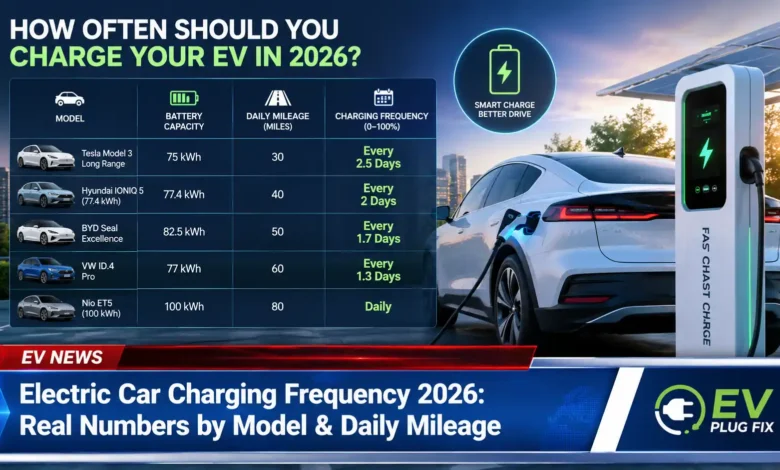
Electric car charging frequency ranks as the number one concern for over 70% of prospective EV buyers, according to a 2025 consumer survey by the American Automobile Association. The anxiety is understandable — nobody wants to be stranded with a dead battery. But here’s what the data actually shows: the average American driver only needs to plug in their EV every five to seven days, and for many, it’s even less frequent than that.
The U.S. Department of Energy confirms that the average American drives approximately 37 miles per day. With most modern electric vehicles offering between 200 and 350+ miles of range on a full charge, that translates to charging every three to ten days under normal circumstances. For countless owners, the routine becomes as effortless as plugging in a smartphone overnight — just a few nights a week instead of daily.
How Daily Mileage Affects Your EV Charging Frequency
Before diving into specific models, it’s essential to understand the three charging levels available to EV owners and how they impact your daily routine:
- Level 1 (standard 120V outlet): Adds 3-5 miles per hour. Ideal for drivers under 40 miles daily who can top up overnight. A full charge takes 24-48 hours.
- Level 2 (240V home or public): Adds 15-30 miles per hour. Most homeowners install these for overnight charging that fully replenishes any EV in 6-12 hours.
- DC Fast Charging (public): Adds 100-200+ miles in 20-40 minutes. Essential for road trips, rarely needed for daily commuting.
The Edison Electric Institute reported that as of 2024, the United States hosts over 4 million public charging ports — a fourfold increase since 2020. Yet a 2023 Pew Research Center survey revealed that 78% of EV owners charge primarily at home. This home-centric charging habit fundamentally reshapes the “charging frequency” question into something far more manageable than traditional fueling.
EV Charging Frequency by Model: Real Numbers for 2026
Not all electric vehicles are created equal when it comes to range and charging needs. Battery size, vehicle weight, aerodynamics, and thermal management all play crucial roles. Here’s how popular 2026 models stack up for the average 37-mile daily driver:
| Model | Battery (kWh) | EPA Range | Daily Miles (avg) | Charge Frequency |
|---|---|---|---|---|
| Tesla Model 3 (Long Range) | 82 kWh | 358 miles | 37 miles | Every 9–10 days |
| Tesla Model Y (Standard) | 62 kWh | 260 miles | 37 miles | Every 7 days |
| Chevrolet Equinox EV | 85 kWh | 319 miles | 37 miles | Every 8–9 days |
| Ford Mustang Mach-E (Ext. Range) | 91 kWh | 312 miles | 37 miles | Every 8 days |
| Hyundai IONIQ 6 (Long Range) | 77.4 kWh | 361 miles | 37 miles | Every 9–10 days |
| Rivian R1T (Max Pack) | 149 kWh | 410 miles | 37 miles | Every 11 days |
| BMW iX (xDrive50) | 111.5 kWh | 324 miles | 37 miles | Every 8–9 days |
| Nissan LEAF (40 kWh) | 40 kWh | 149 miles | 37 miles | Every 4 days |
| Volkswagen ID.4 (Pro) | 82 kWh | 275 miles | 37 miles | Every 7 days |
| Kia EV6 (Long Range RWD) | 77.4 kWh | 310 miles | 37 miles | Every 8 days |
The numbers tell a clear story: premium long-range models can stretch nearly two weeks between charges for average commuters. Even more affordable options like the Nissan LEAF require charging every four days — still far less frequent than a weekly gas station stop for many drivers.
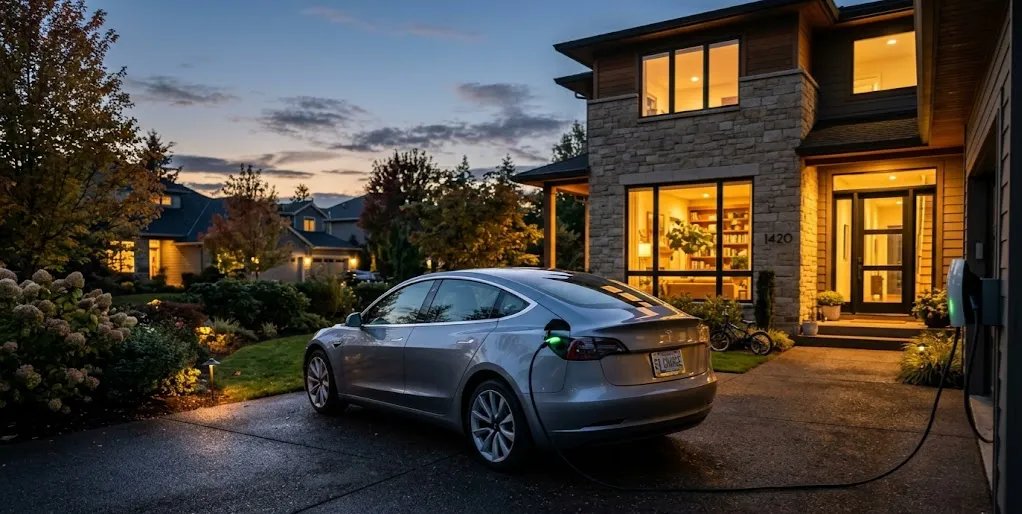
Battery size and range vary significantly across EV models — here’s what that means for your actual charging schedule.
Tesla Ownership: Setting the Benchmark for Charging Convenience
Tesla remains the standard-bearer for EV ownership, and its charging ecosystem is a primary reason why. The Tesla Model 3 charging schedule for most owners involves plugging in two to three times per week at home using a Level 2 Wall Connector. That’s roughly 15-20 minutes of total “effort” per week — plugging in before bed and unplugging in the morning.
Tesla’s Supercharger network exceeded 50,000 global chargers by early 2025, making long-distance travel remarkably straightforward. During cross-country trips, drivers typically stop every 200 miles for 20-25 minutes — comparable to a coffee and restroom break on a traditional road trip. The Model Y, despite its smaller battery compared to the Model 3, still covers a full week or more of typical driving on a single charge.
Hyundai and Kia: Redefining Efficiency Expectations
The Hyundai IONIQ 6 has emerged as an efficiency powerhouse, boasting a drag coefficient of just 0.21 Cd — among the lowest in automotive production. This aerodynamic excellence translates directly to range: EPA-rated at 361 miles, the IONIQ 6 matches Tesla’s best numbers while often undercutting the price.
The Kia EV6, built on the same E-GMP platform, delivers similar efficiency with a game-changing advantage: 800V ultra-fast charging capability. This technology enables a 10% to 80% battery top-up in approximately 18 minutes on a compatible DC Fast Charger. For owners who occasionally need rapid public charging, this speed is transformative.
Both models follow a typical home EV charging habit pattern of two to three sessions per week, or a nightly “top-off” that maintains the battery between 30% and 80% — the scientifically recommended sweet spot for long-term battery health.
The American EV Revival: Ford and GM Deliver Range
Ford’s Mustang Mach-E has converted skeptics who doubted American automakers could compete on EV technology. With 312 miles of range in its Extended Range configuration, plus access to Tesla’s Supercharger network through Ford’s partnership, the Mach-E offers genuine range confidence.
The Chevrolet Equinox EV, launched with a starting price under $35,000 — or under $27,500 after the federal EV tax credit — brings long-range capability to mainstream buyers. At 319 miles of range, Equinox owners charge every 8-9 days under average conditions. GM’s Ultium network aims to deploy 40,000 U.S. charging ports by 2025, further reducing range anxiety concerns.
Electric Trucks and SUVs: Bigger Batteries, Longer Gaps
The Rivian R1T pickup with the Max Pack battery (149 kWh) delivers a staggering 410 miles of EPA-estimated range. For truck owners using their vehicle primarily for commuting and weekend adventures, this can translate to nearly two weeks between charging sessions. Rivian’s proprietary Adventure Network of DC Fast Chargers caters specifically to off-grid explorers who venture beyond conventional charging corridors.
The Ford F-150 Lightning, America’s best-selling vehicle in electric guise, offers up to 320 miles in its Extended Range configuration. Its “Ford Intelligent Backup Power” system can even power a home during grid outages — a feature that redefines the charging equation by making the vehicle an emergency power source for the household.
Battery Health Over Time: What the Data Shows
A persistent concern among prospective EV buyers is battery degradation — the gradual reduction in range and increased EV charging frequency as the battery ages. The evidence, however, is reassuring.
A 2023 study by Recurrent Auto analyzing data from over 15,000 EVs found that the average vehicle retains approximately 88% of its original range after five years of use. Tesla vehicles demonstrated exceptional longevity, with some Model S units exceeding 200,000 miles while maintaining over 80% of their original capacity.
“The real question isn’t ‘how often do I have to charge?’ It’s ‘why did I wait this long to switch?'” — EV ownership adage reflecting the satisfaction of 91% of home-charging EV owners.
Experts recommend these best practices to maximize battery lifespan:
- Keep the state of charge between 20% and 80% for daily driving — reserve 100% charges for road trips only.
- Avoid prolonged exposure to extreme heat or cold without preconditioning the climate system.
- Use Level 2 home charging for daily needs, reserving DC Fast Charging for journeys.
- Utilize the vehicle’s built-in charge scheduling to charge during cooler nighttime hours.
The Psychology of Charging: A Mental Model Shift
Here’s what seasoned EV owners know that new buyers rarely anticipate: you stop thinking about charging the way you think about getting gas. It becomes more like charging your phone — a background routine done at home, overnight, without conscious effort.
J.D. Power’s 2024 U.S. Electric Vehicle Experience Home Charging Study found that 91% of EV owners report satisfaction with their home charging experience, with satisfaction rising significantly after installing a Level 2 home charger. The typical installation cost of $500-$1,200 delivers immediate returns in convenience and time savings.
The owners who face challenges are those without home charging access — apartment dwellers, renters without dedicated parking, or residents in areas with sparse public infrastructure. The U.S. National Electric Vehicle Infrastructure (NEVI) program is addressing this with $5 billion allocated specifically for public charging along major corridors.
Your Personal Charging Schedule: The Bottom Line
For the average driver covering 37 miles daily with home charging access, here’s your realistic EV charging frequency expectation:
- Short-range EV (100–150 miles): Charge every 2–4 days, or nightly top-offs for maximum peace of mind.
- Mid-range EV (200–260 miles): Charge every 5–7 days, or plug in 2–3 nights per week.
- Long-range EV (300–360+ miles): Charge every 8–10 days — only once or twice weekly.
If your commute exceeds the average — say 80-100 miles daily — you can roughly halve those intervals. Even then, most long-range EVs provide three to four days between charges, and an overnight Level 2 session fully restores the battery without any inconvenience.
For road trips, the equation shifts, but networks like Supercharger, Electrify America, EVgo, and ChargePoint have transformed cross-country EV travel into a seamless experience, with charging speeds continuing to improve annually.
Final Verdict: Less Frequent Than You Think
The honest answer to how often to charge an electric car is refreshingly simple: for most owners, less often than they imagine, and in a way that integrates seamlessly into daily life. As battery technology advances and charging infrastructure expands, this answer will only become more favorable.
Whether you’re considering an affordable commuter like the Chevrolet Equinox EV, a performance sedan such as the Tesla Model 3, or an off-road-capable truck like the Rivian R1T, the fundamentals remain consistent: plug in at home when possible, use fast chargers when necessary, and trust the data — you’ll almost certainly be fine.
The real question isn’t about frequency. It’s about why more drivers aren’t making the switch already.
Sources: U.S. Department of Energy, Alternative Fuels Data Center (2024) | Edison Electric Institute, EV Charging Infrastructure Report (2024) | Pew Research Center, Electric Vehicle Survey (2023) | Recurrent Auto, EV Battery Degradation Study (2023) | J.D. Power, U.S. Electric Vehicle Experience Home Charging Study (2024) | Tesla Global Supercharger Data (2025) | U.S. National Electric Vehicle Infrastructure (NEVI) Program Documentation.