EV Battery Life After 8 Years: Real-World Degradation Data & 2026 Market Insights
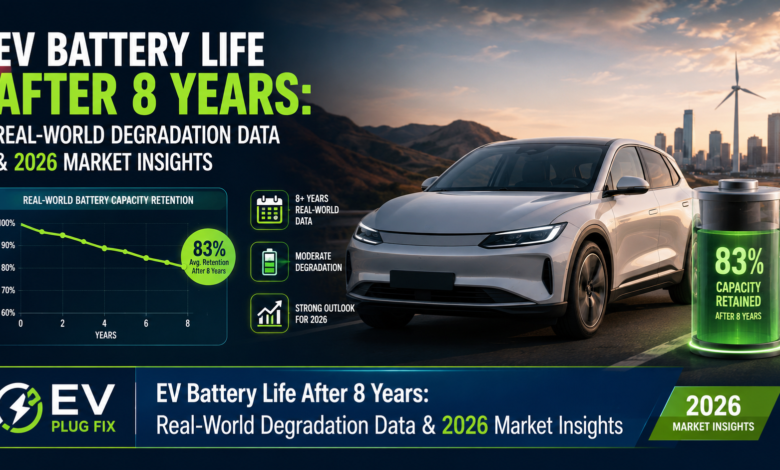
The electric vehicle battery “8-year cliff” has haunted EV buyers for years—a psychological barrier built on a misunderstanding of federal warranty regulations rather than engineering reality. The mandate requiring automakers to warranty high-voltage batteries for 8 years or 100,000 miles has created a pervasive consumer misconception that the battery becomes a ticking time bomb the moment coverage ends. But real-world data tells a very different story: most modern EV batteries will outlast the vehicle itself, maintaining over 80% health well into their second decade of service.
⚡ Key Takeaways: EV Battery Health After 8 Years
- Average Health Retention: Geotab’s study of 22,700+ vehicles shows an average annual degradation of just 2.3%, with typical batteries retaining 81.6% capacity after 8 years.
- Replacement Rates Drop: Batteries built from 2022 onward show replacement failure rates under 0.3%, proving modern liquid cooling extends pack lifespan.
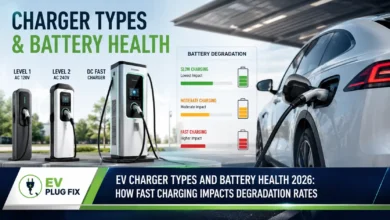
- Charging Behavior Impact: Heavy DC fast charging doubles degradation rates, whereas gentle Level 2 AC home charging maintains battery health above 88% after 8 years.
- Module-Level Repair: Targeted cell module repairs ($3,000–$7,000) have replaced full battery pack swaps, preserving used EV resale values.
The Regulatory “Cliff” vs. Engineering Reality
The number “8” has become embedded in EV folklore, but its origins are purely bureaucratic. In the United States, the 8-year timeline is a regulatory construct, not a biological expiration date. Federal law requires automakers to warranty high-voltage batteries for at least 8 years or 100,000 miles, with California and ZEV (Zero Emission Vehicle) states pushing this further to 10 years or 150,000 miles for specific vehicle classifications.
“EV battery health remains strong, even as vehicles are charged faster and deployed more intensively. Our latest data shows batteries are still lasting well beyond the replacement cycles most fleets plan for.” — Charlotte Argue, Senior Manager of Sustainable Mobility at Geotab
The 70% Capacity Threshold Explained
Most manufacturer warranties are triggered only if the battery’s State of Health (SOH) drops below 70% of its original capacity. Here’s the critical reality check: a battery doesn’t “die” at 69% SOH. It simply holds 69% of the energy it did on day one. A vehicle with an original 300-mile range would still deliver 207 miles—more than sufficient for approximately 95% of daily driving needs.
This fundamentally differs from Internal Combustion Engine (ICE) failure. When a gas engine fails with a blown transmission or thrown rod, the car stops moving. When an EV battery hits the warranty threshold, it merely becomes a smaller fuel tank. Think of it like a gas car whose fuel tank gradually shrank from 15 gallons to 10.5 gallons over a decade—the car drives exactly the same, just requiring slightly more frequent stops.
What the Data Actually Shows: The 2026 Report Card
Multiple independent studies have tracked EV battery health across hundreds of thousands of vehicles, painting a remarkably consistent picture of modern battery durability.
| Study | Sample Size | Average Annual Degradation | 8-Year Capacity Retention |
|---|---|---|---|
| Geotab 2026 | 22,700+ vehicles | 2.3% | 81.6% |
| UK Parliament (2026) | Multiple studies | ~2.0-2.3% | 81.6-85% |
| Carla/AVILOO (2026) | 9,954 battery tests | Varies by model | Top models retain 95%+ at 100,000km |
The Bathtub Curve: Understanding Degradation Patterns
Battery degradation follows a predictable trajectory that battery researchers call the “bathtub curve”:
- The Break-In Drop (Year 1): Owners typically see a 2-3% range reduction during the first year—chemical settling that’s considered normal.
- The Plateau (Years 2-10): Degradation slows dramatically as the SEI layer stabilizes, with losses averaging just 1.5% to 2.0% per year.
- The Acceleration (End of Life): Usually well past 15 years, internal resistance rises enough that degradation accelerates again.
Why Your Charger Matters More Than You Think
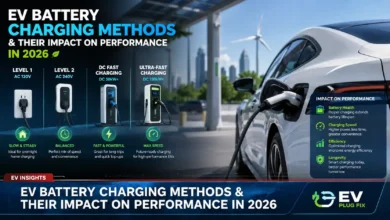
The single most significant factor affecting EV battery longevity isn’t the car you buy—it’s how you charge it. For homeowners looking to maximize battery life, following a comprehensive Home EV Charger Guide can help you establish optimal charging habits from day one.
The Fast Charging Penalty
Geotab’s 2026 analysis identified charging behavior as the dominant operational influence on battery health. Vehicles relying heavily on DC fast charging above 100kW experienced significantly faster degradation:
- Low DC Fast Charging Usage (<12% of sessions): ~1.5% annual degradation
- High DC Fast Charging Usage: ~2.5% annual degradation
- High-Power DC Fast Charging (>40% of DC sessions at 100kW+): ~3.0% annual degradation
This represents a doubling of degradation rates between the best and worst charging practices—and after eight years, the difference between 88% and 76% remaining capacity.
The Home Charging Advantage: Level 2 AC Charging
Level 2 home charging (AC charging) is chemically “gentle” on battery cells. The slow flow of ions gives them time to properly intercalate into the graphite anode structure, preventing the lithium plating that creates damaging dendrites during fast charging.
The thermal management advantages are equally significant. DC fast charging generates substantial heat through I²R losses, forcing the vehicle’s cooling system to work overtime. While modern liquid cooling systems are effective, they can’t eliminate all hot spots within the pack—and heat accelerates the SEI growth that gradually consumes active lithium ions.
Model-Specific Performance: Who’s Leading the Pack?
Not all batteries age equally. A comprehensive Swedish study analyzing nearly 10,000 battery health tests revealed significant variation between manufacturers and battery chemistries.
Top Performers After 100,000km
Carla’s Electric Vehicle Battery Study tested 9,954 vehicles between 2022 and 2026 using AVILOO diagnostic technology, with the following leaders emerging:
- Kia e-Niro (64 kWh): 97.25% battery health — less than 3% degradation after 100,000km
- Hyundai Kona Electric (64 kWh): 97.18% battery health
- Kia EV6 (77.4 kWh): 95.95% battery health
- Volvo XC40 Recharge (69 kWh CATL): 94.70% battery health
- Polestar 2 (78 kWh CATL): 94.35% battery health
- BMW i3 (120 Ah): 93.77% battery health
The Chemistry Factor: LFP vs. NCM
Battery chemistry significantly influences long-term health. Even within the same Tesla Model 3 variant, significant differences emerged:
- CATL LFP batteries: 93.3% capacity retention
- LG Chem batteries: 91.5% capacity retention
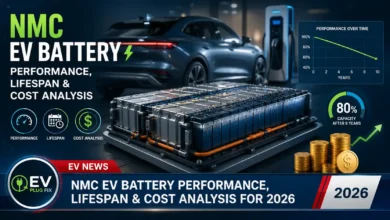
- Panasonic batteries: 88.2% to 89.8% capacity retention
Lithium Iron Phosphate (LFP) batteries are increasingly favored for their longevity and thermal stability, despite offering slightly lower energy density than Nickel Manganese Cobalt (NCM) alternatives.
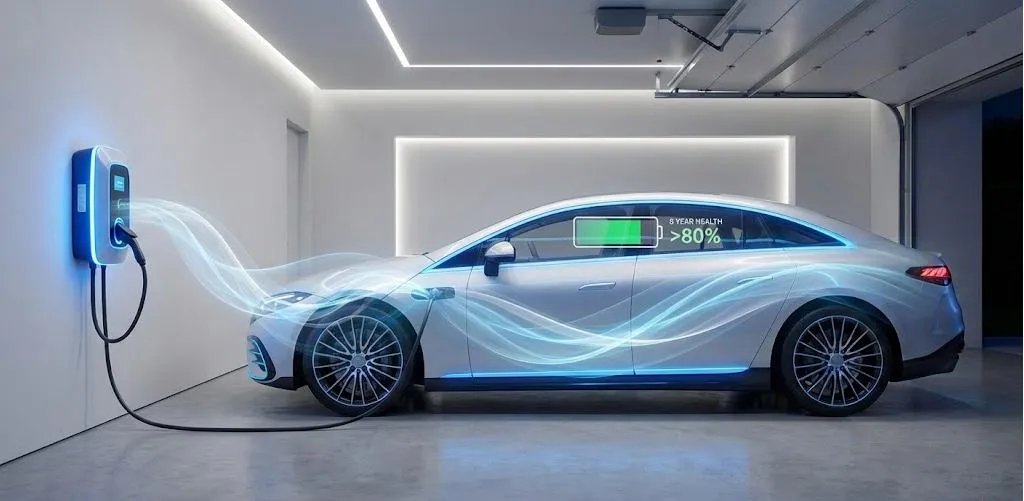
Module-level repairs now offer a cost-effective alternative to full battery replacement.
The Economic Reality: Repair, Replace, or Repurpose?
When the “8-year mark” arrives, most owners face a financial decision, not a technical one. The fear is economic: will the car’s value plummet to zero? Let’s examine the landscape.
Battery Replacement Costs in 2026
Full battery replacement costs have decreased significantly as the aftermarket matures:
- Compact EVs (Nissan Leaf, Chevy Bolt): $5,000 to $8,000
- Mid-size EVs (Tesla Model 3/Y, Hyundai Ioniq 5): $10,000 to $15,000
- Luxury/Long-range EVs (BMW iX, Ford F-150 Lightning): $12,000 to $25,000
Labor typically adds $1,000 to $3,000, with certified EV technicians charging $150-$250 per hour.
The Rise of Module-Level Repair
EV batteries aren’t monolithic units—they consist of 10-16 smaller modules. When a battery “fails,” it’s usually one or two weak cells within a single module dragging the entire system down. Specialized shops can now:
- Remove the pack, identify the bad module, and replace only that module
- Complete repairs for $3,000 to $7,000—significantly less than full replacement
- Access remanufactured packs from crashed vehicles for approximately $9,000
This fundamentally changes the depreciation equation. An 8-year-old EV with a potential $5,000 repair is vastly different from one requiring $20,000 in replacement costs.
Depreciation Trends: The Utility Floor
Data indicates EVs depreciate faster than gas cars in the first 5 years (~58% loss vs ~45% loss), driven largely by price cuts and technology obsolescence concerns. However, at Year 8, the curve flattens significantly.
“Project Geotab’s degradation rate forward and the average pack does not reach the 70% capacity threshold until around year 15. The battery is no longer the part of the car most likely to fail. In most cases, it is now the part most likely to outlive the car around it.” — Wall Street Journal analysis
An 8-year-old EV reaches a “utility floor”—a vehicle that runs reliably for 3 cents per mile has baseline intrinsic value to commuters, delivery drivers, and students, preventing the price from hitting zero.
The Maintenance Advantage
While the car may be worth less, it costs significantly less to maintain:
- Consumer Reports data shows EV repairs and maintenance are roughly 50% lower than gas cars over the vehicle’s life
- By Year 8, a gas car typically needs timing belt, water pump, spark plugs, transmission flush, and alternator replacement
- An EV has none of these components
- Primary failure points for 8-year-old EVs are suspension (control arms, bushings) and 12V accessories (window motors, AC compressors)—identical to gas cars
Second Life: What Happens After the Car?
When an EV battery truly reaches the end of its useful life in a vehicle (typically defined as sub-70% capacity), it’s far from worthless.
Stationary Energy Storage
A battery with 60% capacity is unsuitable for a car (acceleration draws huge current) but perfect for stationary energy storage systems (ESS). These “second-life” batteries can:
- Store solar energy for nighttime use
- Provide grid stabilization services
- Serve as backup power for homes and businesses
Innovative homeowners are already exploring EV Backup Power solutions that leverage their vehicle’s battery for whole-home energy resilience during outages, effectively giving the battery a second job before it even leaves the garage.
The Circular Economy
Eventually, after 15 years in a car and 10 years in grid storage, the battery reaches end-of-life. Contrary to the myth that “EV batteries end up in landfills,” lithium-ion batteries are far too valuable to discard:
- They contain cobalt, nickel, and lithium—all increasingly valuable commodities
- Companies like Redwood Materials use hydrometallurgy (chemical dissolving) to recover 95-98% of these metals
- Recovered materials are often purer than mined ore and sold back to battery manufacturers
- The battery from your 2025 EV will likely become the battery for a 2050 EV
Frequently Asked Questions About 8-Year EV Battery Life
Does an EV battery die when the 8-year warranty expires?
No. The 8-year / 100,000-mile limit is a legal warranty requirement, not a battery lifespan limit. Modern liquid-cooled EV batteries typically retain over 80% capacity at year 8 and can last 12 to 15+ years.
How much does it cost to replace an 8-year-old EV battery?
Full replacement costs range from $5,000 for compact models to $15,000+ for long-range vehicles. However, module-level repairs ($3,000 to $7,000) now fix bad cell groups without replacing the entire battery pack.
Does fast charging degrade EV batteries faster?
Yes. Frequent DC fast charging above 100kW increases annual degradation to roughly 2.5%–3.0%, whereas gentle Level 2 AC home charging maintains degradation around 1.5% per year.
The Verdict: The 8-Year Mark in 2026
The fear of the 8-year mark is a relic of early adoption anxiety. The data is unambiguous:
- Batteries are remarkably durable: Expect 12-15 years of reliable service from a modern liquid-cooled pack, with many vehicles exceeding this significantly.
- Degradation is manageable: You’ll lose range, but likely only 15-20% over a decade.
- Home charging is the key: The single best investment for your vehicle’s future value is a high-quality Level 2 home charger. It protects battery chemistry, reduces thermal stress, and enables the “shallow cycling” habits that extend life. For a complete overview of protection strategies, including insurance considerations, check out our EV Insurance Costs 2026 guide to understand how battery health affects your premiums.
- Repair costs are falling: Module-level repairs have transformed the economics of battery maintenance, making repair a viable alternative to replacement.
- The circular economy is here: EV batteries don’t die—they get reborn as stationary storage or recycled into new batteries.
For the EV owner, the 8th birthday of their car isn’t a funeral—it’s just another registration renewal. And with the fuel savings accumulated over those eight years, it’s likely a very happy birthday indeed.