EV Bidirectional Charging: V2L, V2H & V2G Explained for 2026 Home Backup Power
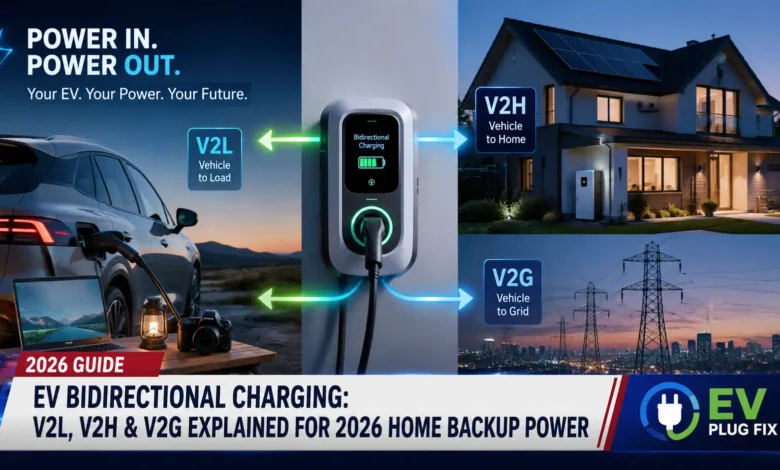
Bidirectional charging is reshaping how modern electric vehicles function, turning them from simple transportation tools into powerful mobile energy stations for 2026 and beyond. This technology allows electricity to flow both ways: into your EV for charging, and out of it to power your home, appliances, or even the public utility grid. Whether you’re facing a storm-induced power outage or looking to cut energy costs, understanding V2L, V2H, and V2G is essential for any EV owner. For those installing systems in rental properties, the Best Rental Property EV Charger options now include bidirectional-ready units that add significant property value.
code
Code
⚡ Key Takeaways: Bidirectional EV Charging
- V2L (Vehicle-to-Load): Plug-and-play AC power (1.8 to 3.6 kW) for camping, power tools, and emergency appliances directly from your EV.
- V2H (Vehicle-to-Home): Powers your home’s main electrical panel (6 to 11 kW) during grid outages and slashes energy bills via peak shaving.
- V2G (Vehicle-to-Grid): Feeds stored battery energy back to the public grid during peak demand hours to generate revenue or utility credits.
- Multi-Day Backup: A standard 60 kWh EV battery can power essential household loads (1,000W) for up to 60 consecutive hours.
V2L vs. V2H vs. V2G: The EV Energy Trio
Bidirectional charging is an umbrella term for three distinct technologies: Vehicle-to-Load (V2L), Vehicle-to-Home (V2H), and Vehicle-to-Grid (V2G). While all involve moving power out of your EV, their scale, purpose, and hardware requirements differ significantly. Before investing in any system, reviewing a comprehensive Home EV Charger Guide can help you understand the infrastructure needed for each application.
| Technology | Direction | Typical Power Output | Primary Use Case |
|---|---|---|---|
| V2L (Vehicle-to-Load) | EV → Individual Devices | 1.8 – 3.6 kW | Camping, tailgating, emergency appliance backup |
| V2H (Vehicle-to-Home) | EV → Home Electrical Panel | 6 – 11 kW | Whole-home backup, peak shaving, solar self-consumption |
| V2G (Vehicle-to-Grid) | EV ↔ Utility Grid | Up to 11 kW | Grid stabilization, energy arbitrage, revenue generation |
V2L (Vehicle-to-Load): Your EV as a Mobile Power Station
V2L is the easiest and most accessible form of bidirectional charging available today. It allows you to plug standard appliances directly into your EV, transforming it into a quiet, fume-free generator. When you activate V2L, the vehicle’s onboard inverter converts the battery’s DC power into AC power suitable for household devices. This capability pairs well with EV Backup Power strategies, offering both portable and whole-home solutions depending on your needs.
What Can V2L Power?
Most V2L systems provide between 1.8 and 3.6 kW of power, which is sufficient for essential devices but not for large home appliances. Knowing the wattage helps you prioritize during an outage.
✔️ V2L Can Power These
- Refrigerator/Freezer (~150W)
- LED Lighting (10 bulbs ~100W)
- Laptops and Phone Chargers (20-100W)
- CPAP Machine (~30W)
- Electric Kettle or Microwave (up to 1,500W, one at a time)
- Power tools on a job site
❌ V2L Might Struggle With
- Central HVAC Systems (3,500+ W)
- Electric Clothes Dryer (~5,000W)
- Electric Water Heater (~4,500W)
- Multiple high-wattage appliances simultaneously
“With a fully charged 60 kWh EV battery, you can run a refrigerator, some lights, a TV, and internet (totaling 1,000W) for an astonishing 60 hours straight before the battery is depleted.”
V2H (Vehicle-to-Home) and V2G (Vehicle-to-Grid): Advanced Integration
While V2L is plug-and-play, V2H and V2G require more complex installations but offer significantly greater benefits, especially for whole-home resilience and energy savings. When considering the long-term value of these systems, understanding EV Insurance Costs 2026 can help you budget for the additional coverage these advanced setups may require.
Vehicle-to-Home (V2H)
V2H integrates your EV directly with your home’s electrical system via a bidirectional charger and a transfer switch. During an outage, this setup can automatically power your entire home—not just a few devices—for days, depending on battery size and consumption. V2H also allows for intelligent energy management, like charging your EV with cheap off-peak electricity or solar power and using that energy during peak-rate hours to slash bills.
Vehicle-to-Grid (V2G)
V2G is the most advanced bidirectional application. It allows your EV to push energy back to the utility grid, helping stabilize it during peak demand. This creates a new revenue stream, as EV owners can receive payments or credits for participating in grid services, particularly in regions with dynamic energy pricing. V2G is currently in pilot phases, but standardization efforts like ISO 15118-20 are paving the way for mainstream adoption.
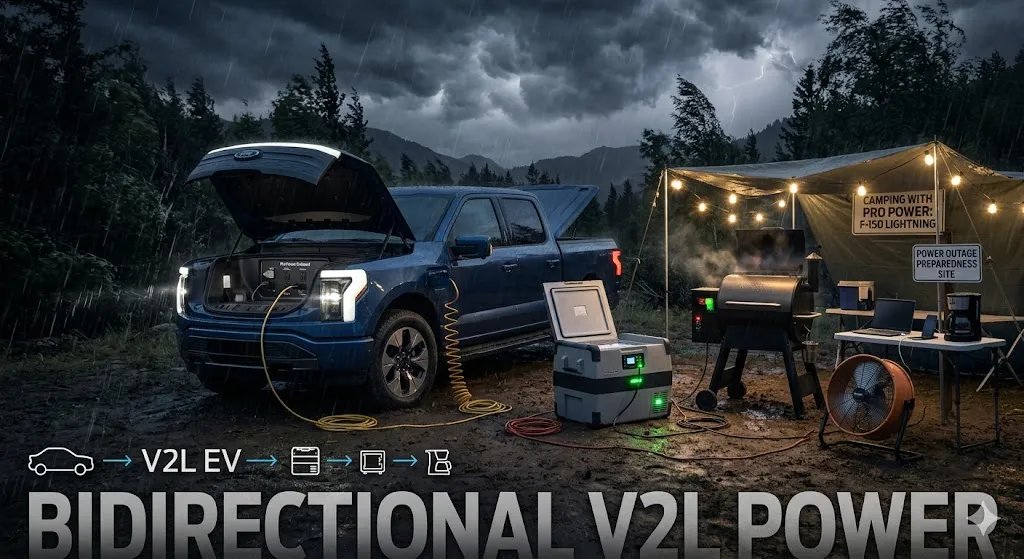
V2L technology transforms your EV into a silent, fume-free generator for camping and outdoor adventures.
2026 EV Models with Bidirectional Charging
Many of the most popular EVs on the market now feature some form of bidirectional charging. Always confirm with your manufacturer, but here are key examples available in 2026.
| Vehicle | V2L Output | Battery Capacity | Notes |
|---|---|---|---|
| Hyundai IONIQ 5 / IONIQ 6 | 3.6 kW | 72.6 – 77.4 kWh | Built-in V2L outlet + adapter |
| Kia EV6 / EV9 | 3.6 kW | 77.4+ kWh | V2L via adapter or outlet |
| Ford F-150 Lightning | 9.6 kW (240V) | 98 – 131 kWh | Ford Intelligent Backup Power (V2H) |
| Nissan LEAF (CHAdeMO) | 6 kW (V2H) | 40 – 62 kWh | Requires CHAdeMO V2H charger |
| Volkswagen ID. Models | Up to 3.6 kW | 52 – 77 kWh | V2L capable via adapter |
How to Use Your EV for Home Backup: A Step-by-Step Guide
Whether you have V2L or a full V2H system, here’s how to make the most of your EV’s bidirectional capabilities during a power outage. Understanding proper cable management is crucial—refer to the EV Charging Cable Guide for best practices on safely connecting and routing cables during backup operations.
- Confirm Your EV’s Capability: Check your owner’s manual. Ensure you have the correct V2L adapter or that your home has a bidirectional charger installed.
- Assess Your Power Needs: Calculate the total wattage of devices you need to run. Keep the total load under 80% of your EV’s maximum output to prevent circuit tripping.
- Deploy and Activate: For V2L, park safely, plug in your adapter, and activate V2L mode via the infotainment screen. For V2H, the system should switch automatically when grid power fails.
- Connect and Monitor: Plug in essential devices. Monitor your vehicle’s state of charge. Most manufacturers recommend keeping the battery above 20% to preserve its health and ensure you can still drive if needed.
Frequently Asked Questions About EV Bidirectional Charging
What is the difference between V2L, V2H, and V2G?
V2L (Vehicle-to-Load) powers individual electrical devices via plug outlets. V2H (Vehicle-to-Home) connects to your home’s electrical panel to power your whole house during grid outages. V2G (Vehicle-to-Grid) feeds power back to the public electrical grid during peak demand to earn utility bill credits or income.
Does bidirectional charging damage or drain my EV battery?
Occasional V2L or V2H use has a minimal impact on battery health. EV Battery Management Systems (BMS) automatically set discharge safety floors (typically 20%) to prevent over-discharging and preserve long-term battery life.
Which electric cars support bidirectional charging in 2026?
Popular 2026 EV models with bidirectional charging include the Hyundai IONIQ 5 and 6, Kia EV6 and EV9, Ford F-150 Lightning, Nissan LEAF, and Volkswagen ID series.
The Verdict: Is Bidirectional Charging Worth It in 2026?
Absolutely. For homeowners, V2L offers immediate peace of mind—a silent, fume-free backup for essentials. For the energy-conscious, V2H is a transformative step toward energy independence, allowing you to leverage your car as a home battery to slash bills and maximize solar investment. While V2G is still emerging, it represents a future where every EV owner can be an active participant in the energy grid, turning transportation costs into a potential revenue stream. Bidirectional charging is no longer a futuristic concept; it’s a practical, powerful tool available in 2026.