7 Deadly EV Charging Habits That Destroy Your Battery in 2026 (And How to Fix Them)
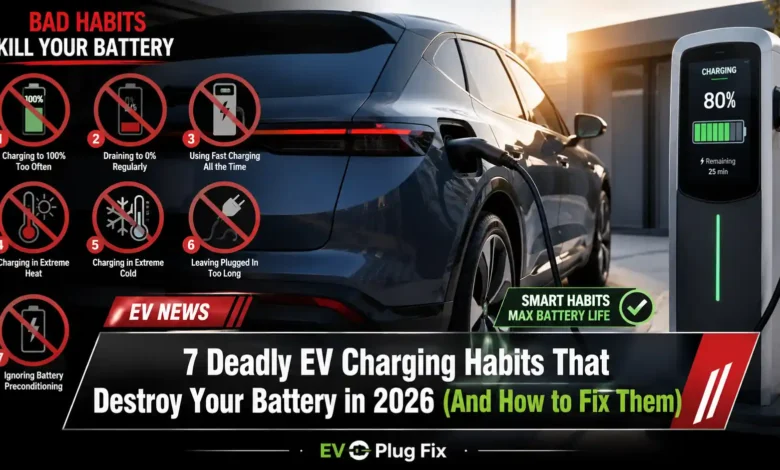
Modern electric and hybrid vehicle batteries are engineering marvels, designed to propel you for well over 150,000 miles. But here’s the catch: they only achieve that longevity when treated with care. Poor charging habits alone can erode usable battery capacity by a staggering 20–40% within just 3–5 years.
Understanding the “why” behind battery degradation is the first step to prevention. Let’s explore the most damaging behaviors and, more importantly, how to adopt practices that will keep your battery healthy for the long haul.
1. The “Always 100%” Mistake: Why Daily Full Charges Are Harmful
It seems intuitive: a full battery means maximum range. However, consistently charging your EV to 100% for daily driving is one of the most common and damaging habits. At full charge, the battery’s cathode undergoes maximum lattice stress, and the electrolyte oxidizes at an accelerated rate. This habit alone can reduce battery capacity by 4–6% per year.
- The cathode is maximally lithiated, creating structural stress.
- High voltage accelerates electrolyte decomposition.
- Cell imbalances worsen over time, straining the Battery Management System (BMS).
- Tesla data shows vehicles charged to 100% daily lose 2.5x more capacity over 5 years.
2. The “Range Anxiety” Trap: Allowing the Battery to Drain to 0%
Just as dangerous as overcharging is the habit of deep discharging—running your battery down to near-zero. This practice is equally destructive.
- Deep discharge can cause copper shunting: copper dissolves and redeposits as dendrites inside cells.
- The anode undergoes irreversible structural damage when fully depleted.
- Cells dropping below minimum voltage thresholds suffer permanent capacity loss.
- Recovery charges after deep discharge generate excess heat, compounding the damage.
- Frequent deep discharges may cause the BMS to isolate damaged cells, resulting in sudden range loss.
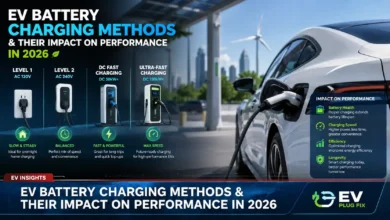
3. The “Need for Speed” Addiction: Overusing DC Fast Charging (Level 3)
DC fast chargers are a godsend for road trips, offering an 80% charge in 20-30 minutes. However, this convenience comes at a significant cost to battery health when used too frequently. Think of it like a high-intensity sprint; it’s effective but incredibly taxing on the system.
- High current causes rapid lithium-ion movement, generating substantial internal heat.
- Repeated thermal stress causes micro-cracking in electrode materials.
- Lithium plating occurs when ions move faster than the anode can absorb them, forming metallic lithium deposits that are electrochemically inactive.
- Electrolyte degrades faster at high temperatures, permanently reducing ionic conductivity.
- Most manufacturers recommend limiting DC fast charging to 1–2 times per week at most.
“DC fast charging is an invaluable tool for long-distance travel, but for daily use, Level 2 charging is the clear winner for preserving your battery’s long-term health.”
4. The “Set It and Forget It” Problem: Leaving the Battery at 100% for Extended Periods
There’s a big difference between charging to 100% the night before a road trip and leaving your vehicle at 100% for days or weeks in a garage. The latter causes significant long-term degradation. Even without driving, the battery suffers from ‘calendar aging.’
- High SoC combined with ambient heat dramatically accelerates electrolyte decomposition.
- Calendar aging—capacity loss due to time at high charge states—occurs even without driving.
- The SEI (Solid Electrolyte Interphase) layer grows thicker at high SoC, permanently reducing available lithium.
5. The Storage Oversight: Storing at Very Low or Very High Charge Levels
If you plan to store your EV for a period of time, the charge level at which you store it is critically important. Neglecting this can cause irreversible damage.
- Storage below 10% SoC risks complete self-discharge, which can permanently destroy individual cells.
- Storage above 90% SoC subjects cells to ongoing high-voltage stress with no electrical load.
- Incorrectly stored batteries can lose 10–20% of permanent capacity in a single storage period.
6. The Temperature Trap: Charging in Extreme Heat or Cold
Temperature is arguably the most impactful environmental factor on battery health. Charging in very hot or cold conditions without proper battery conditioning causes disproportionate damage.
- Charging below 0°C (32°F) causes lithium plating—ions cannot intercalate properly and metallic lithium deposits form.
- Charging above 40°C (104°F) exponentially accelerates every known degradation mechanism.
- Repeated large temperature swings during charging stress electrode materials through expansion and contraction.
7. The “Deal” That Costs More: Using Non-Certified or Incompatible Chargers
While it might be tempting to save money on a third-party charger, using uncertified equipment introduces significant risks. OEM equipment is specifically designed to prevent these issues.
- Uncertified chargers may deliver voltage spikes beyond the BMS’s compensation range.
- Poor charger-to-vehicle communication can result in incomplete charge termination, causing trickle overcharge.
- Ground fault issues in uncertified hardware can expose battery cells to uncontrolled current.
- Some adapters bypass safety protocols built into OEM charging systems.
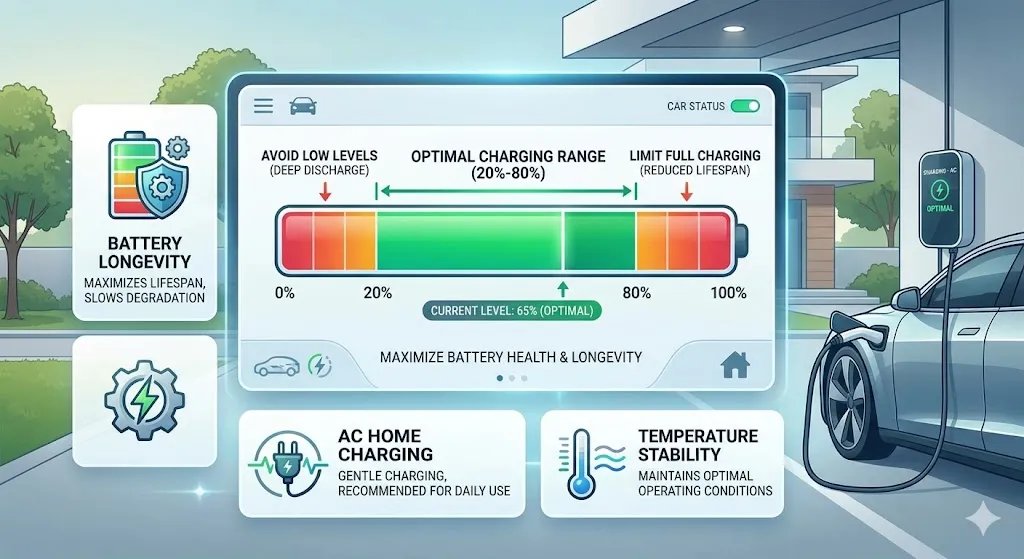
Following the 20-80% charge rule is the single most effective habit for preserving your EV battery’s long-term health.
Understanding the Damage: The Science of Battery Degradation
Understanding the mechanisms of degradation helps explain why these habits are so harmful. There are four primary degradation pathways:
| Degradation Pathway | Description | Primary Triggers |
|---|---|---|
| SEI Layer Growth | A protective film on the anode thickens over time, consuming lithium and reducing capacity. | High SoC and elevated temperatures. |
| Lithium Plating | Metallic lithium deposits on the anode, creating dendrites that can cause internal short circuits. | Cold-temperature charging and excessive fast charging. |
| Cathode Cracking | Expansion and contraction of cathode particles causes micro-cracks, reducing active material surface area. | Full charge/discharge cycles and thermal stress. |
| Electrolyte Decomposition | The liquid electrolyte chemically breaks down, increasing internal resistance and reducing ion conductivity. | High temperatures, high voltage, and fast charging. |
Best Practices for Maximizing EV Battery Life in 2026
Now that we’ve covered the enemies of your battery, let’s focus on the habits that will protect it. The good news is that the solutions are simple and straightforward.
1. Live by the 20–80% Rule
The single most impactful change is limiting daily charging to the 20–80% State of Charge (SoC) window. This range places the least stress on both electrodes and maximizes cycle longevity.
- Set your charge limit to 80% in your vehicle’s settings or app.
- Plug in before SoC drops below 20%.
- Reserve 100% charges for days when you genuinely need maximum range.
2. Make Level 2 AC Charging Your Daily Standard
Level 2 chargers (240V, 7–22 kW) represent the ideal daily charging method. They are slow enough to minimize heat while being fast enough to fully replenish your car overnight.
- Install a Level 2 home charger (EVSE) — typically $300–$800 installed.
- Use workplace Level 2 charging during business hours.
- Reserve DC fast charging (Level 3) for road trips and emergencies only.
3. Master the Art of Scheduled Charging
Modern EVs allow you to schedule charging to complete just before departure. This reduces the time spent at a high SoC and can be timed with off-peak electricity pricing for additional savings.
- Program your departure time so the car finishes charging 30 minutes before you leave.
- This also ensures the battery is at the optimal temperature for departure.
- Available on virtually all 2020+ EVs via the native app or in-vehicle settings.
4. Always Precondition Before Fast Charging
If you must use a DC fast charger, especially in cold weather, activate battery preconditioning beforehand to warm the pack to the ideal temperature range (20–35°C / 68–95°F).
- Most modern EVs precondition automatically when a fast charger is set as the navigation destination.
- Manually activate preconditioning via the app 20–30 minutes before arrival in cold conditions.
- Never fast charge a battery below 5°C (41°F) without preconditioning.
5. Be Temperature-Aware
Heat is the primary enemy of battery longevity. Manage your battery’s thermal exposure throughout the charging process.
- Park in the shade or in a garage whenever possible during charging.
- Let the pack cool for 20–30 minutes after aggressive driving before plugging in.
- In summer, plug in immediately upon arriving home — active cooling only runs when plugged in.
- Avoid leaving the car in direct sunlight for extended periods at a high SoC.
6. The Monthly Full Charge (and Quick Drive)
While daily full charges are harmful, an occasional charge to 100% is useful. It allows the BMS to recalibrate the SoC estimation and balance individual cells in the pack.
- Perform a full charge approximately once per month.
- Drive the vehicle immediately after—do not leave it at 100% for more than a few hours.
- This also helps identify cells that are significantly out of balance.
Final Verdict: Small Changes, Massive Impact
Battery degradation in electric vehicles is inevitable—but it is not uncontrollable. The habits outlined in this guide account for the vast majority of premature capacity loss seen in real-world EV usage, and all of them are easily correctable.
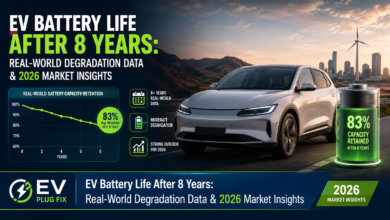
By adopting the 20–80% daily charging rule, prioritizing Level 2 AC charging, using scheduled charging, and managing temperature, EV owners can realistically expect their battery to retain 80% or more of its original capacity even after 200,000 miles or 10+ years of use.
Battery care is not complicated. Charge less aggressively, charge in moderate temperatures, and avoid the extremes of both full and empty. These three principles alone will have a greater impact on your battery’s longevity than any software update or maintenance service ever could.